The innovations of artificial intelligence (AI) continue to evolve with no signs of slowing down. This evolution in technology has created uncertainties about how it could be regulated, and the responsibilities that individuals and organizations have in terms of using it.
The phased implementation of the AI EU Act since 2024 has clarified some of these uncertainties. As organizations that operate in the EU must comply with these enforceable requirements, a shift in how EU laws impact the U.S. has become apparent, both now and in the future.
While the EU AI Act HR compliance requirements stem from Europe, American organizations with ties to the EU are already beginning to embrace these laws. When this is combined with domestic plans for AI legislation, it’s clear there’s a shift to adhere to these changes before they’re fully in place.
Learn more about what the EU AI Act is and how it impacts U.S. HR teams. We cover everything you need to know about keeping up with regulatory progress, both domestically and in Europe.
In This Article
- Understanding the EU AI Act and Its Impact on HR
- The U.S. AI Laws to Be Aware Of
- How These Laws Affect HR Organizations
- Actionable Steps for an AI Transparency Audit
- Digital Labor Law Compliance for Remote Teams
Understanding the EU AI Act and Its Impact on HR
The EU AI Act is the world’s first fully comprehensive legal framework for AI. The act regulates on the premise of risk, instead of the type of technology. The premises are separated into four clear tiers based on their potential risk to safety, health and human rights.
These four-tiered risks are listed below:
- Unacceptable risk: AI systems under this tier are a significant risk to rights, health and safety. This category includes untargeted facial image scraping, social scoring by public authorities, emotional recognition in work or institutional organizations, and subliminal manipulation through AI.
- High risk: This tier is for permitted AI systems that will be subject to strict assessments, requirements and risk management. It includes systems and areas noted in Annex III of the AI Act, encompassing sectors such as law enforcement, employment, critical infrastructure and others.
- Limited risk: AI systems listed under this tier are required to be transparent about human and AI interactions. This tier includes things like deepfakes and chatbots, which need to inform users that they are interacting with AI.
- Minimal risk: This tier is for unregulated AI applications, such as spam filters and AI-enabled games. Most apps available in the EU were in this category in 2021, but the rise of generative AI is changing how many apps are categorized.
Understanding the foundational aspects of the EU AI Act is crucial for identifying areas deemed high-risk AI systems under employment law.
The EU AI Act HR Compliance Requirements
Compliance is an essential part of remaining in-line with modern standards and protecting sensitive data. HR organizations in the U.S. should be aware of several areas of the EU AI Act’s tiered requirements.
These obligations include:
- Adhering to the strict requirements associated with high-risk tiered HR systems like CV scanning for recruitment, task allocation and performance monitoring.
- Informing all potential candidates and employees when AI has been used as part of any decision-making process in hiring or firing.
- Providing detailed, clear information about the purpose of using any AI systems.
- Avoiding systems on the “unacceptable” tier, such as social scoring and detecting emotions at work.
- Maintaining comprehensive logs and documentation for regulatory review purposes.
- Implementing a risk management system plan during the life cycle of AI systems.
AI should work with humans in a professional HR setting, rather than replacing them. Humans should always remain in control, helping to reduce bias and discriminatory practices.
Why HR Teams in the U.S. Can’t Ignore This Legislation
Why is AI legislation that began in Europe becoming so important for compliance matters in the U.S.? The adoption of AI innovations worldwide has streamlined many processes. However, numerous risks and challenges remain associated with them.
The EU AI Act applies to Europe but isn’t exclusive to the EU. Any American company that screens EU candidates or plays a role in managing European staff members can find itself liable under this act. For example, American companies like Workday are already standardizing to EU rules, making them compliant and enabling their use by organizations throughout the European Union.
As U.S. organizations embrace the EU AI Act for HR compliance requirements, new standards in transparency are being set. People will soon expect this level of transparency from all organizations, which is why American laws are being introduced that reflect this.
The U.S. AI Laws to Be Aware Of
Being prepared for forthcoming AI laws is vital. While there’s no single AI law established on a federal scale, standards such as the National Institute of Standards and Technology (NIST) AI Risk Management Framework and laws like Section 5 of the FTC Act provide strong guidance on adherence.
However, there are key state and local laws that HR organizations will depend on to remain compliant in the future. As AI continues to expand and demands for stricter regulations increase, the following are the latest and soon-to-be-mandated AI laws.
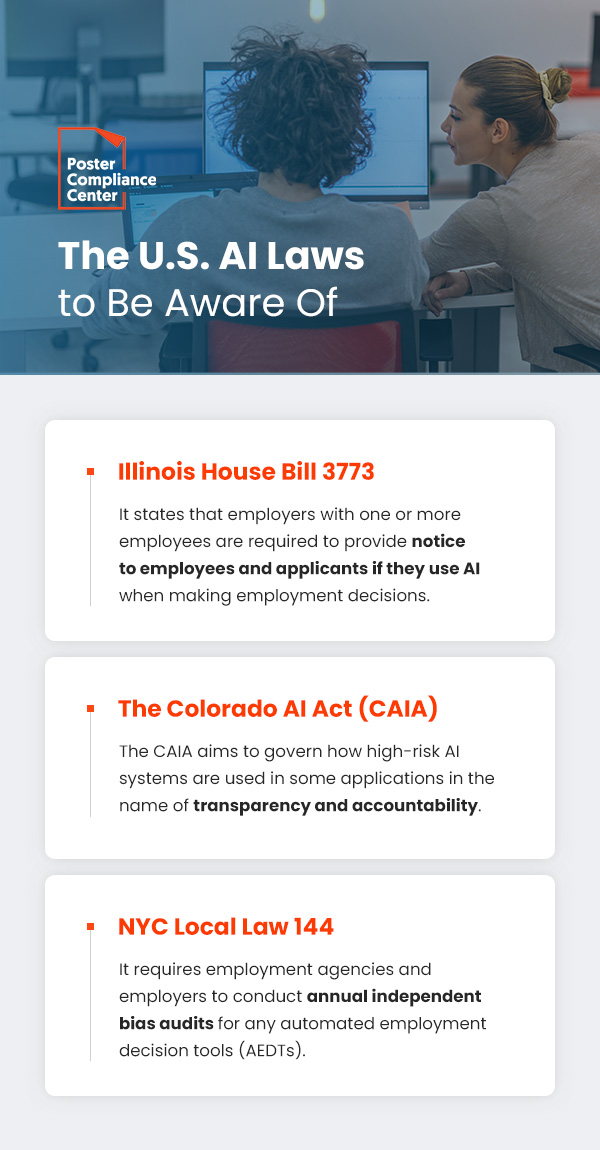
Illinois House Bill 3773
Illinois’ House Bill 3773 took effect on January 1, 2026. It states that employers with one or more employees are required to provide notice to employees and applicants if they use AI when making employment decisions. The notice must be posted in a clearly visible location where employee notices are commonly placed. It should summarize the rights of employees under this law, such as protection from discriminatory practices.
This bill is another sign of Illinois’ aggressive stance on AI, building on the 2025 Mental Health AI Law, which prohibits AI from providing autonomous mental health therapy. Looking to the future, the Illinois AI Video Interview Act 2026 updates point to progress in ensuring candidates are aware when AI is being used to sort through video interview submissions.
These changes mean that AI has concrete legislation in Illinois, with a primary focus on preventing discrimination in employment. They also ensure the boundaries of mental healthcare are kept strictly ethical. Failure to do this may be deemed a civil rights violation under the Illinois Human Rights Act.
The Colorado AI Act (CAIA)
The Consumer Protections for Artificial Intelligence, also called the Colorado AI Act, was originally expected to go into effect on February 1, 2026, but is now delayed until June 30, 2026. The CAIA aims to govern how high-risk AI systems are used in some applications in the name of transparency and accountability. Its main focus is in sectors deemed “vital,” such as employment, finance, healthcare, legal and education.
Some core principles and goals of the CAIA include:
- Preventing algorithmic discrimination: Algorithmic discrimination is defined as using an AI system that leads to unlawful treatment of an individual or group protected under Colorado or federal law.
- Risk management expectations: Employers must implement clear risk management policies that are regularly updated to mitigate discriminatory risks.
- Consequential decision definitions: This is defined as a decision with a potential effect on financial, legal, educational or employment opportunities that involves the use of an AI system.
- Annual impact assessments: The act will likely require employers to conduct impact assessments annually, explaining data usage, algorithmic discrimination risks, metrics and the purpose of the AI system.
Developers are required to post a public statement summarizing their use of high-risk AI systems on their website. It should include a clear and concise notice of AI’s involvement in any consequential decisions, presented in plain language and an accessible format. Exemptions to this rule include small businesses with 50 or fewer employees and AI systems approved by federal agencies. The scope of this act is likely to influence future similar laws across other U.S. states.
NYC Local Law 144
New York City’s Department of Consumer and Worker Protection (DCWP) has enforced this law since 2023. It requires employment agencies and employers to conduct annual independent bias audits for any automated employment decision tools (AEDTs). The employer must also post a summary of these third-party audit results on its website.
Key parts to know about high-risk AI systems for employment law and HR for NYC Local Law 144 include:
- Requirements for audits to analyze for bias related to race, gender and other intersectional areas.
- Notices to job candidates about the use of AEDTs within 10 business days, including the data collected, evaluation criteria and requesting alternative assessments.
- Understanding that this law also applies to remote roles related to New York City.
For HR organizations, it’s important to make a distinction between NYC Local Law 144 and the EU AI Act. While the act in Europe represents a broader focus on fundamental rights and AI that can impact HR organizations, NYC Local Law 144 focuses specifically on employment and HR tech.
How These Laws Affect HR Organizations
The Colorado AI Act’s effective date is delayed, and the Illinois AI Video Interview Act 2026 updates aren’t yet set in stone. However, the momentum has already begun. Failure to comply with Local Law 144 can result in a fine of $500, followed by additional penalties of up to $1,500 for every subsequent default. For organizations operating under the EU AI Act, noncompliance can result in a fine of up to €40 million or 7% of their global turnover. These are maximums for certain violations and severe cases.
Whether it’s an impending law or one that’s already in place, these laws impact how consumers and employers perceive the HR industry. With California’s AI Transparency Act and the New Hampshire deepfake law, HB 1432, already in place, AI legislation is expected to continue to grow.
Actionable Steps for an AI Transparency Audit
The transformative impact of AI on HR can provide the industry with faster, more streamlined solutions. But automated employment decision tools compliance can’t be overlooked. Conduct an AI transparency audit to verify that you comply with GDPR, the EU AI Act and other forthcoming laws.
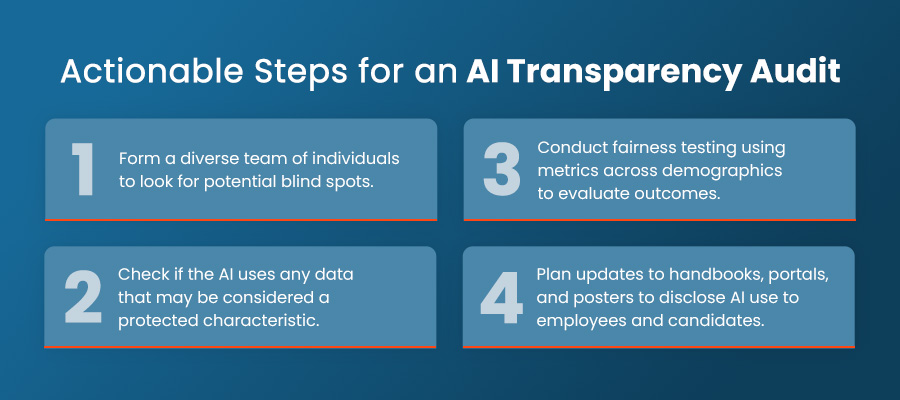
Here are four actionable steps for HR organizations looking to conduct an AI transparency audit:
- Team formation and documentation: Form a diverse team of individuals to look for potential blind spots. Create an inventory of all AI systems and tools used in HR, including data flows. Note where data is stored, how it’s processed and the risks presented based on the EU AI Act’s tiered risks and any other existing or forthcoming AI laws.
- Data and bias evaluation: Check whether the AI uses any data that may be considered a protected characteristic, such as socioeconomic status, race or religion. Evaluate and document data lineage to develop clear insights into the source of your data.
- Fairness testing: Conduct fairness testing to evaluate outcomes. Use metrics across various demographics to check for consistency and any discriminatory results. If you identify any potential issues, consider rebalancing the datasets or adjusting the AI algorithm. Document any findings to help create a clear audit trail for future reference.
- Transparency and feedback: Consider how you’re going to update handbooks, application portals and physical posters to disclose the use of AI to employees and potential job candidates. Encourage feedback through channels, assessing them for any comments regarding bias or appeals to decisions.
Finally, remember that accountability and responsibility are still very much a human matter. AI is there to assist with HR processes, not lead them.
Digital Labor Law Compliance for Remote Teams
New U.S. employee AI notification laws for 2025 present HR organizations with a stark new reality where compliance and AI systems are commonplace. To address these issues, consider innovative tools like eComply360 to ensure digital labor law compliance for remote teams.
The tool tracks any legislative shifts, so HR organizations don’t have to, allowing them to focus on achieving results while remaining compliant. By digitalizing mandatory employee notices, eComply360 sends mandatory notices directly to intranets. Digital notices also contribute to a strong and clear audit trail, something you can’t achieve by only using physical posters.
New Standards in Compliance
The EU AI Act is an integral part of establishing how AI is going to be regulated and implemented. This act may be the first of many new regulatory standards for HR organizations. As AEDTs and compliance laws continue to grow, having the peace of mind that you’re supported and staying one step ahead of impending legislation is crucial.
Poster Compliance Center takes the guesswork out of compliance. Our team of experts and innovative software handles the complexities of research and monitoring to comply with all federal, state and local labor laws. With a portfolio that covers all 50 states and Washington, D.C., we ensure your business always has the most recent applicable labor law posters.
Contact us today and learn more about how we can support your organization.