
The European Union (EU) Pay Transparency Directive is a policy that requires global companies to reassess compensation strategies. Companies that operate in the EU must provide mandatory disclosures starting June 2026. Keeping pay structures secret is no longer an option. HR leaders must understand the directive and prepare an action plan to ensure compliance.
The regulations apply to EU member states. However, U.S. multinational employers often adopt the strictest standards to streamline administration and mitigate legal risk. Strategizing for cross-border labor law compliance avoids managing dual compliance standards. It also positions your company as a leader in fair pay practices.
In This Article
- What Is the EU Pay Transparency Directive?
- Key Directive Requirements for Employers
- Why U.S. Employers Can’t Ignore the EU Directive
- How the EU’s Pay Transparency Directive Can Shape Future U.S. Policies
- A Compliance Roadmap for U.S. Multinationals
- Frequently Asked Questions
What Is the EU Pay Transparency Directive?
The EU Pay Transparency Directive enforces the principle of equal pay for equal work. It aims to close the gender pay gap by making compensation structures visible, objective and accountable. It also applies to public and private sectors, covering all workers in member states. These workers may have employment contracts or employment relationships as defined by law, collective agreements and practice.
Previous regulations relied on employees to report discrimination. However, this directive places the transparency obligation on the employer. It reverses the burden of proof — originally, employees needed to gather data and build a case. Under the new directive, the employer must prove that no discrimination occurred.
This legal change necessitates switching from reactive defense to proactive auditing. Employers must now possess the data and the objective job classifications to prove fairness.
Work of Equal Value Assessment
To comply with the directive, you must understand which roles require equal pay. In the U.S., pay equity analysis often groups employees by job titles or similar duties. The EU directive requires a more granular, objective assessment to determine if two roles are of equal value. To establish a gender-neutral evaluation and classification system, you must consider the following criteria:
- Skills: Evaluate the knowledge and capabilities applicants and employees must have to perform the job. These capabilities include hard skills, such as educational qualifications and technical certifications, and soft skills, such as people management and communication. Measure the required skills for the role, not necessarily the skills the applicant or employee possesses.
- Effort: Effort encompasses the physical and mental strain associated with the role. You must objectively compare jobs that look different on the surface. For instance, you might compare the physical effort of a warehouse role against the mental effort required for a data entry role. If the aggregate effort score is similar, you can consider the roles of equal value.
- Responsibility: This factor measures the scope of accountability. For instance, you can measure each role’s financial, managerial and administrative responsibilities. You can compare a management role for a small team to that of an individual contributor managing a significant budget.
- Working conditions: Working conditions encompass physical surroundings and psychological factors. For instance, you must factor in the noise, temperature, hazards, stress, isolation and customer aggression for each role. A role performed in a hazardous environment can be deemed more valuable than a role performed in a comfortable office. You can overlook this criterion in U.S. compensation models, but it is crucial in the EU framework.
Key Directive Requirements for Employers
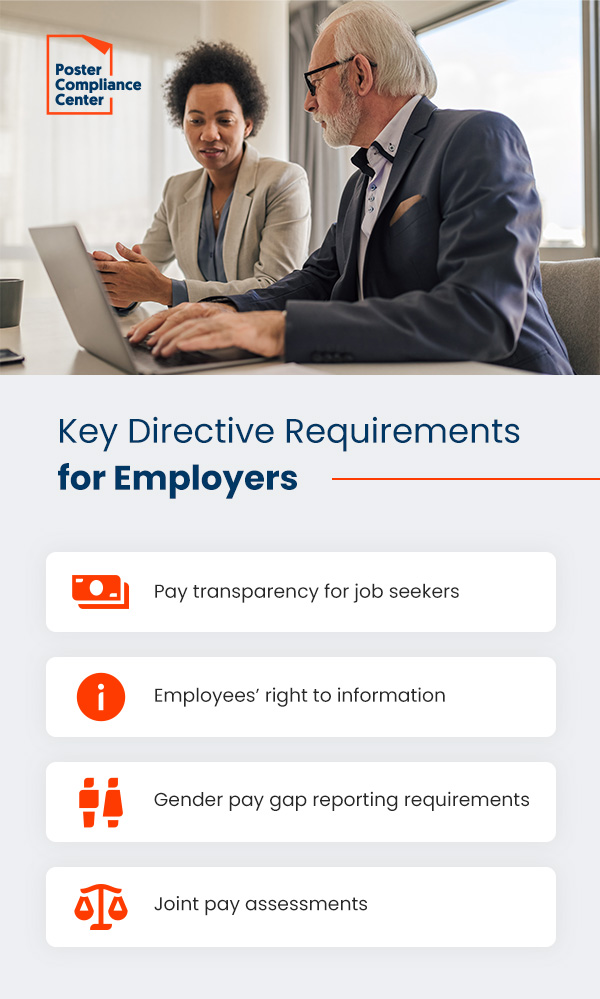
The directive has four major requirements that create transparency at every stage of the employment life cycle:
1. Pay Transparency for Job Seekers
The directive requires you to provide the initial pay level or range in the job ad or before the first interview. You can’t negotiate salaries based on a candidate’s previous earnings. It also necessitates a predetermined, market-validated range for every role. Candidates have the right to make informed decisions about compensation without having to request the data.
2. Employees’ Right to Information
Employees can request information on their pay level and the average pay per sex for workers performing work of equal value. This right ensures that the workforce knows about the internal pay structures. You must provide this information within a reasonable period, often two months from the date of the request.
3. Gender Pay Gap Reporting Requirements
You must publish information regarding the gender pay gap. The frequency is based on your company’s size:
- Over 250 workers: First report by June 7, 2027, then annually.
- 150-249 workers: First report by June 7, 2027, then every three years.
- 100-149 workers: First report by June 7, 2031, then every three years.
Reports should include the:
- Mean and median of the overall gender pay gap.
- Gender pay gap for complementary or variable pay components.
- Share of workers per sex who receive complementary or variable pay components.
- Distribution of workers by sex across pay quartiles.
- Pay level information of workers by sex and category who perform work of equal value, if the national law or monitoring authority requires it.
You must publish a summary of this pay gap information where the public can access it. For instance, this could be on your company website or another public portal. You should also share the full report with your workers, the workers’ representatives, and the monitoring or labor authorities. Each member state will have its own process.
4. Joint Pay Assessments
You must carry out a joint pay assessment with workers’ representatives if a gender pay gap of at least 5% exists and can’t be justified by objective, gender-neutral factors. Your assessment must identify the differences, reasons and solutions to remedy the situation. This is a shift from reactive audits to mandatory, collaborative correction.
Why U.S. Employers Can’t Ignore the EU Directive
The directive creates a “Brussels Effect,” which is a phenomenon where EU regulations become the global standard. This phenomenon happens because it’s costly and complex for companies to maintain different standards for different markets. If your company has EU branches, you must comply with the directive for those branches. However, having separate U.S. and EU requirements can create internal friction.
Maintaining a transparent, employee-friendly model for EU staff but a guarded, opaque model for U.S. staff is a liability risk. It creates a disparity in the employee experience that can damage morale and employer branding. U.S. employees and investors can access the data you publish for EU compliance. Once they find this data, they may ask why your company doesn’t provide similar pay transparency domestically.
Also, global mobility programs create a compliance challenge under the directive. When U.S. employees are seconded to an EU member state, they generally fall under the protection of local labor laws. This means a U.S. manager who transfers to a Paris office may gain the right to request pay data. They may compare their compensation to peers in that location.
If the employee requests average pay levels for their category, does that category include their U.S. counterparts? However, if you limit the comparison group to the EU, disparities can arise due to employee packages. For instance, you may be providing housing allowances and other financial assistance. These disparities can skew the gender pay gap data or trigger compliance violations.
How the EU’s Pay Transparency Directive Can Shape Future U.S. Policies
The EU Pay Transparency Directive can affect U.S. companies by acting as a catalyst for U.S. policies. The directive can transform the system from a complaint-driven to a reporting-driven system. U.S. pay equity laws typically rely on employees filing lawsuits. The EU’s mandatory reporting identifies issues before lawsuits occur. Here’s how the directive can specifically impact U.S. policies:
It Can Accelerate the Shift to Proactive Transparency
Because of the directive, more U.S. states may adopt similar proactive transparency laws. Some states, like Illinois and California, already have pay transparency requirements. Other states may follow, while also creating broader rights for requesting employees’ pay information.
The directive normalizes the idea that pay data belongs to the employee. As U.S. multinationals adapt to the EU standard, they prove that such transparency is operationally feasible. This change can counter key arguments of opponents of similar U.S. legislation.
It Can End Salary History Inquiries
Salary history ban in the EU impacts U.S. policies as it reinforces an already ongoing trend. Many states have banned asking for salary histories to prevent perpetuating past discrimination. The directive’s strict enforcement will likely encourage the remaining U.S. jurisdictions to follow suit. This change makes salary history questions obsolete.
It Can Normalize Pay Equity Audits
The directive normalizes regular pay equity audits. In the U.S., many companies only conduct these audits when facing litigation. The EU requirement for joint pay assessments can push U.S. companies to perform these audits proactively and globally. These audits can identify and correct gaps before they become reportable statistics.
It Can Move Vendors to Standardize Payment Transparency Systems
Human resource information system (HRIS) and payroll vendors may update their systems to handle EU reporting requirements. U.S. companies that access these platforms can take advantage of the new features as they roll out. Once fully available, these technologies make it easier for U.S. legislators to mandate the same reporting requirements. The technologies can also reduce compliance costs.
A Compliance Roadmap for U.S. Multinationals
A pay transparency compliance checklist can help you navigate the shifting landscape. Waiting until June 2026 to react can leave you scrambling to update job architectures and payroll systems. To help you get started, consider the following steps:
1. Conduct a Global Pay Equity Audit
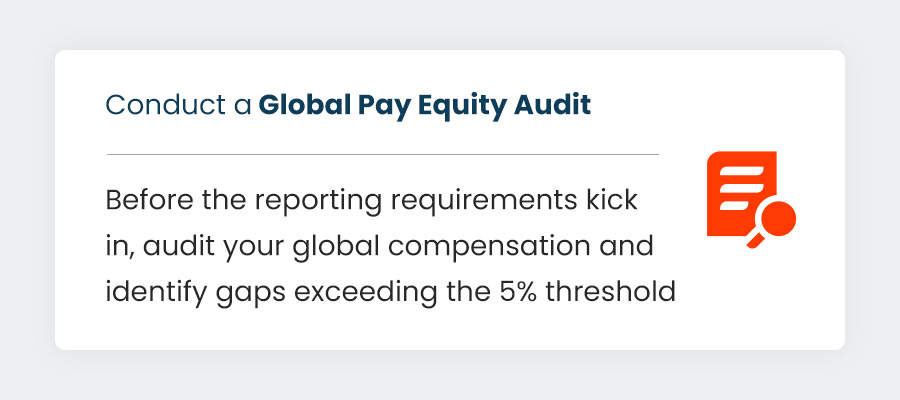
Adopting global pay equity audit strategies helps with remediating issues privately before they become public data. Before the reporting requirements kick in, audit your global compensation and identify gaps exceeding the 5% threshold. Investigate the causes and use the EU’s criteria for work of equal value as your reference.
2. Harmonize Job Architectures
Review your job classifications to ensure they are gender-neutral and based on objective criteria, such as skill and responsibility. For example, ensure you evaluate a senior manager in Berlin using the same value criteria as a senior manager in New York. Global consistency allows for accurate cross-border comparison and reporting. It reduces the administrative burden of maintaining separate job catalogs for different regions.
3. Update Hiring and Posting Protocols
Update your recruitment processes to include salary ranges for all positions, regardless of location. Train hiring managers to stop asking about salary history and instead focus on the budgeted range for the role. This standard ensures you remain compliant in the strictest jurisdictions. It also lets you offer a fair candidate experience everywhere.
4. Leverage Technology for Notification Compliance
Compliance is also about communication. As laws change, you must inform your workforce of their rights and your new policies. A digital compliance platform ensures that your workers know about the pay transparency law updates and internal procedural changes right away. These updates can reach them whether they’re in a physical office in Paris or a home office in Texas.
Frequently Asked Questions
To further understand the impacts of the EU Pay Transparency Directive, consider these common questions and their answers:
Does the EU Pay Transparency Directive Apply to U.S. Companies?
Yes. Even if your company is headquartered in the U.S., the directive applies if your company has subsidiaries, branches or employees with employment contracts in an EU member state. You can apply these standards globally to maintain a consistent employer brand and avoid administrative complexity.
What Are the Penalties for Noncompliance With the Directive?
Member states are required to establish penalties that are effective, proportionate and dissuasive. While fines vary by country, the directive mandates that penalties must reflect the gravity of the infringement. Unlike some U.S. regulations that result in nominal fines, these penalties can include full compensation to the victim for lost wages and bonuses, with no fixed upper limit. Additionally, the reputational damage caused by public reporting of uncorrected pay gaps can be just as costly as the financial penalties.
When Does the EU’s Pay Transparency Directive Take Effect?
The directive entered into force in June 2023, but member states have until June 7, 2026, to transpose it into national law. By June 2026, all employers in the EU must comply with the local laws to enforce the directive. For reporting purposes, companies with 150 or more employees generally must submit their first report on the gender pay gap by June 7, 2027, based on data from calendar year 2026. Companies with 100-149 employees must submit their first report by June 7, 2031.
Secure a Compliance Partner Today With Poster Compliance Center
As pay transparency laws evolve from a European mandate to a global standard, keeping your workforce informed is becoming critical to your compliance strategy. Whether you’re managing a hybrid team across the U.S. or preparing for stricter posting requirements, you need a partner who watches the regulatory horizon for you.
At Poster Compliance Center, we specialize in taking the complexity out of compliance. Our corporate compliance solutions ensure your physical locations in the U.S. are always up to date with mandatory labor law posters. If you work with a hybrid or remote team, our eComply360 can deliver digital notices. Review our solutions today to get started.