
With more employees working remotely or with hybrid schedules, traditional labor law compliance strategies prove insufficient. The tech sector has a high potential for remote work, creating an immediate, multijurisdictional compliance burden that manual processes cannot sustain. Unlike industries that expand state by state, tech companies often operate across multiple jurisdictions from inception. They hire remote talent, engage contractors and scale through mergers and acquisitions (M&A) at a pace that outpaces HR infrastructure.
The result is a fragmented compliance landscape where outdated posting methods, reactive legal reviews and decentralized tracking create compliance gaps. For mid-market tech companies managing distributed workforces, the solution isn’t working harder. It’s centralizing smarter.
In this article
- The Unique Compliance Gaps in the Modern Tech Sector
- Strategizing Multistate and Remote Workforce Compliance
- Advanced Strategies for Worker Classification in Tech
- Centralized Compliance Management: A Mid-Market Necessity
- Beyond the Physical Poster: Digital Solutions for Distributed Teams
- Future-Proofing Compliance: Proactive Auditing and Tracking
The Unique Compliance Gaps in the Modern Tech Sector
Tech sector remote compliance challenges differ fundamentally from traditional industries, requiring specialized approaches for distributed workforces.
Technology companies face three primary hurdles:
-
Growth velocity: Rapid scaling can outpace HR infrastructure and compliance capacity.
-
Workforce composition complexity: Blended teams of employees, contractors and gig workers require different legal frameworks.
-
Immediate geographic talent dispersal: Operations spanning multiple states within months of launch complicate compliance.
Each of these hurdles creates distinct compliance risks that require proactive management. An HR compliance checklist for rapidly scaling tech companies must include automated tracking to prevent gaps from becoming enforcement actions.
Rapid Scalability and M&A Activity
Rapid hiring and mergers create immediate, complex compliance obligations across jurisdictions. When a SaaS company expands from 80 to 300 employees in six months, compliance requirements multiply faster than teams can adapt.
M&A activity intensifies this challenge. Due diligence scrutiny means labor law gaps, data protection lapses or worker misclassification can complicate deal execution. Proactive management protects deal integrity.
High Utilization of Contract and Gig Workers
Managing compliance for a blended workforce combining full-time employees with independent contractors requires navigating multiple, often conflicting, legal frameworks. Tech companies frequently engage specialized contractors, creating classification complexities.
Contract workers may require different postings based on jurisdiction and engagement length. Gig workers add another dimension, as their physical location determines requirements independent of the company headquarters.
The Immediately Multistate Nature of a Remote Workforce
Geographic dispersal magnifies compliance risks across a fragmented legal environment. This fragmentation creates multistate payroll challenges where mismanaged payroll, improper tax withholding and local regulation violations multiply across jurisdictions.
Each jurisdiction maintains distinct requirements, so federal, state, county and city-level obligations can vary significantly.
Strategizing Multistate and Remote Workforce Compliance
Effective fully remote workforce labor law compliance requires addressing jurisdiction determination, legislative tracking and hybrid work arrangements. These challenges create unintended tax liabilities and operational strain across time zones. The first and most critical challenge is determining legal nexus, which is the point where a company becomes obligated to comply with a state’s regulations.
Navigating “Nexus” for Employees in New States
The complexity of determining jurisdiction for employees working in states where the company has no physical office creates significant exposure. When remote employees relocate without notifying HR, organizations may unknowingly violate posting requirements for months.
Nexus extends beyond physical presence. A single remote employee can trigger obligations for state-specific postings, unemployment insurance, workers’ compensation and tax withholding.
Keeping Pace With Constant Legislative Changes
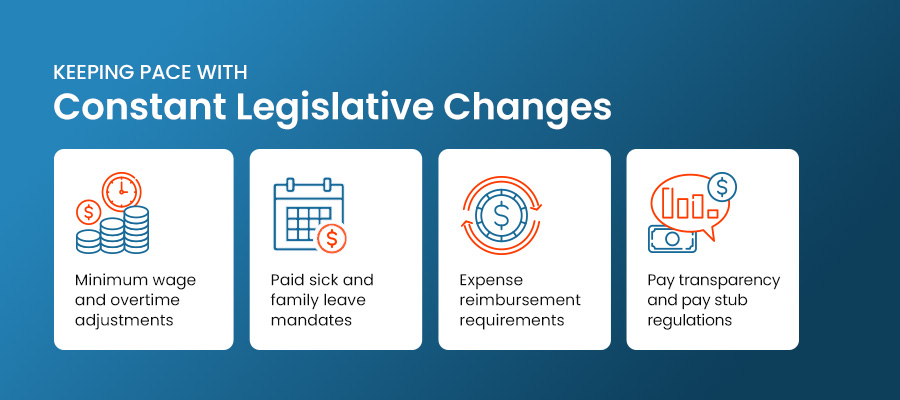
Minor but mandatory changes in state, county and city-level labor laws create constant compliance risks.
Common updates include:
-
Minimum wage and overtime adjustments: These annual changes across multiple jurisdictions require immediate poster updates.
-
Paid sick and family leave mandates: Expanding state programs often have specific posting requirements.
-
Expense reimbursement requirements: New policies affect remote work equipment and connectivity costs.
-
Pay transparency and pay stub regulations: Evolving disclosure obligations vary by location.
Centralized compliance for multistate employers provides infrastructure to track these changes systematically.
The Challenge of Hybrid and “Nomadic” Employees
Employees splitting time between home and office or traveling frequently create posting challenges. Regardless of where employees are located, employers must ensure that all workers have access to labor law posters to stay compliant. Digital solutions ensure continuous access to required postings.
Advanced Strategies for Worker Classification in Tech
Worker classification compliance for software engineers presents unique challenges. The autonomy, specialized skills and remote nature of tech jobs blur legal lines between independent contractors and employees.
Why Specialized Tech Roles Increase Classification Complexity
Software engineers and consultants are often mistakenly categorized as 1099 contractors. A software engineer working exclusively for one company, using company tools and following company processes likely qualifies as an employee regardless of contractual language.
Organizations can avoid costly reclassification actions by understanding the nuances of worker classification. The analysis extends beyond control to economic reality, examining whether the worker is economically dependent on the company.
Quantifying the Cost of Misclassification
Companies face back taxes and penalties for unpaid unemployment insurance, workers’ compensation and benefits contributions. The Department of Labor’s Fair Labor Standards Act (FLSA) imposes additional fines for wage violations.
The FLSA compliance guide details misclassification penalties, including back wages, liquidated damages and civil penalties up to $2,515 per violation. Class action lawsuits involving multiple workers can result in multimillion-dollar settlements, creating significant financial exposure for growing organizations.
Centralized Compliance Management: A Mid-Market Necessity
SaaS labor law compliance management has become essential, driven by regulatory scrutiny and high noncompliance costs. A single source of truth for labor law postings delivers advantages in risk management and cost control.
Establishing a Single Source of Truth for All Locations
A centralized platform ensures all employees have access to correct, up-to-date postings. Corporate compliance solutions provide infrastructure for managing jurisdiction-specific requirements without separate systems.
When California updates its paid sick leave poster, the system automatically distributes the new version to California employees while maintaining existing postings elsewhere. Labor law poster cost reduction technology emerges from this centralization.
Simplifying Audits and Demonstrating Due Diligence
A centralized system provides an auditable record of compliance efforts. HR leaders can immediately demonstrate what posters were displayed, when updated and which employees had access.
A fully remote compliance audit trail captures:
-
Poster distributions: Record which posters were sent to which employees.
-
Employee acknowledgments: Document that employees received and reviewed the required materials.
-
Update deployments: Keep logs showing when regulatory changes triggered new poster versions.
-
Access logs: Track employee portal access and engagement duration.
This documentation proves due diligence, often reducing penalties if violations are discovered.
Beyond the Physical Poster: Digital Solutions for Distributed Teams
Digital labor law posters for distributed tech teams address practical and legal requirements for remote workforces. Multistate labor law posting requirements for technology companies cannot be met through traditional methods when employees never visit physical offices.
Meeting Legally Compliant Digital Posting and E-Delivery Mandates
Regulations specify accessibility standards, acknowledgment mechanisms and continuous availability that simple email distribution cannot satisfy.
Digital platforms like eComply360, accessible through our Virtual Compliance Portal (VCP), ensure remote employees receive required postings in legally compliant formats. The platform maintains 24/7 access, tracks engagement and automatically updates content.
Proving Employee Acknowledgment and Access
Tracking employee access and acknowledgment creates defensible records for auditors. Documentation proving employees received and acknowledged postings can mean the difference between warnings and substantial fines.
A digital compliance platform for tech companies captures detailed access records, review duration and acknowledgments. This positions organizations ahead of emerging requirements in the evolving tech and work policy landscape.
Future-Proofing Compliance: Proactive Auditing and Tracking
A documented, auditable history appeals to upper management’s focus on liability reduction. Leveraging technology to mitigate risks has become strategic for tech companies.
Dedicated platforms create unchangeable compliance activity records. When regulators question compliance history, organizations demonstrate what actions were taken and when updates were deployed.
Tech startup labor law compliance presents unique challenges as companies transition from informal practices to systematic controls. Implementing proactive auditing during growth prevents unaddressed compliance needs. Moving from reactive fire-fighting to systematic management transforms compliance from a cost center to a strategic advantage.
Simplify Your Remote Workforce Compliance
Poster Compliance Center provides corporate-level compliance solutions designed specifically for multistate, distributed technology-sector workforces. Our centralized platform eliminates the operational strain of managing jurisdiction-specific labor law poster requirements across all 50 states, the District of Columbia, Puerto Rico, Guam and the U.S. Virgin Islands.
With automatic updates whenever mandatory federal, state, county or city-level laws change, your organization maintains full compliance without manual tracking or printing.
Our eComply360 digital platform ensures remote and hybrid employees receive legally compliant access to required postings, while our audit-ready tracking systems provide timestamped documentation of all compliance activities.
Explore how a centralized compliance partner can reduce risk and streamline your HR operations.