In the U.S., 1 in 2 employees is open to leaving their jobs, and only 26% are likely to recommend their workplace. Since high turnover is costly, companies must improve retention rates, especially in competitive industries.
Labor law compliance plays a huge strategic role. It shows you respect employee rights and care about their needs. It also protects your company’s reputation and employee engagement. In building your employee retention strategy, use this article as your guide to foster a compliant work environment.
Contact Us with Compliance Training Questions
In this Article:
- How Labor Law Compliance Builds Employee Trust
- How Compliance Improves Employee Morale and Engagement
- Compliance vs. Turnover Costs
- How to Leverage Compliance for Better Retention
How Labor Law Compliance Builds Employee Trust
Trust is key to retaining top talent, and you build it by creating a culture of compliance. Whether you’re a franchise owner, a small business owner, or a manager at a large corporation, here’s how labor law compliance improves your employees’ trust:
1. Ensures Fair Pay Practices
Fair labor practices and retention strategies are intertwined, as compliance affects job satisfaction. For instance, minimum wage law compliance tells employees they’re paid what they’re due. Higher compensation and improved benefits also show that you value their contributions.
In 2024, 15% of employees left their organizations due to pay, while both pay and benefits were the top turnover reasons. While displaying required posters, like the Employee Rights Under the Fair Labor Standards Act (FLSA), assures employees of your compliance, timely and accurate paychecks also speak to your professionalism and efficient administrative practices.
Some states, like Washington, California and Colorado, also have transparency laws. For instance, in Washington, you must disclose salaries for job ads, internal transfers and promotions. In California, you must also disclose your median gender and racial pay gaps if you have more than 100 employees. While adherence avoids penalties and violations, transparency also decreases employees’ intent to quit by 30%.
Additionally, managers can communicate how salary decisions are made and the steps employees can take to increase their salary. Clear communication about pay equity is 13 times as important for retention as high-level discussions about pay. When employees perceive unfair practices, they lose confidence in a company, affecting their performance.
Your HR department should ensure accurate worker classification. Misclassification causes major violations of wage and hour regulations. For instance, the FLSA protects employees with minimum wage and overtime requirements, but an independent contractor may not be entitled to them.
2. Offers Consistent Policies
Labor laws are the foundation for your organizational rules. For instance, complying with the Family and Medical Leave Act (FMLA) means you offer employees at least 12 workweeks of leave over 12 months when applicable. Adhering to the Occupational Safety and Health (OSH) Act also ensures safe working conditions.
Effective organizational rules, or green tape, improve employee retention by providing reasonable and consistent enforcement. They offer employees reliability and predictability, reduce role conflict and ambiguity, and promote equal employment opportunities, increasing job satisfaction and rule-following behavior.
3. Provides Visible Reminders
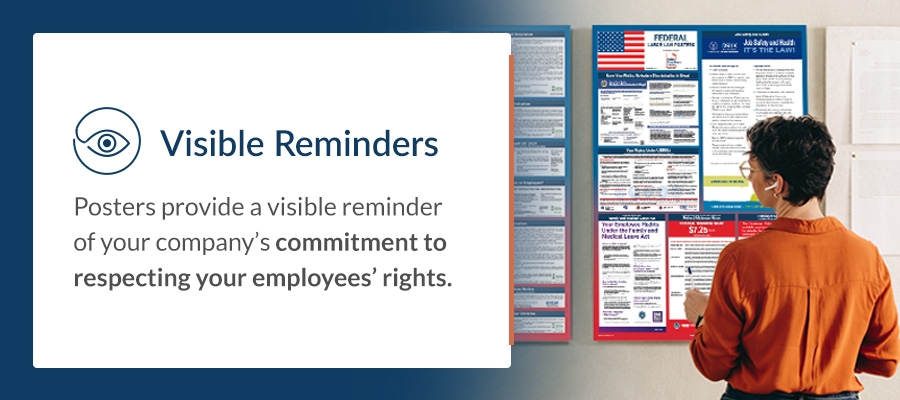
Poster compliance is part of labor law compliance. Posters provide a visible reminder of your company’s commitment to respecting your employees’ rights. The federal, state and local governments mandate some labor law posters. Law adherence tells employees you’re willing to follow the rules even when no one is watching.
Additionally, some labor law posters are industry-specific. For instance, federal contractors should display the Employee Rights on Government Contracts notice, and the health care industry may need the HIPAA Compliance poster. Though some notices are not required, their availability increases your company’s transparency, reducing potential turnover.
4. Builds Psychological Safety
Psychological safety and workplace compliance work together to improve employee retention. Psychological safety lets people take interpersonal risks, disagree openly and speak up about concerns without fear of retaliation. Eighty-nine percent of employees agree that this is essential at work, while social scientists explain that it’s one of people’s basic needs. Improving psychological safety helps employees perform their best, fostering a culture built on trust. This trust creates high engagement levels and healthy workplace relationships.
Additionally, disrespect is one of the common reasons why employees leave their jobs. Without a proper compliance process, your workplace encourages misconduct. For instance, not displaying the Know Your Rights: Workplace Discrimination is Illegal poster reflects how you treat sexual harassment. Your employees may view your company as unethical or lacking in accountability.
Employees who feel psychologically safe are more likely to report misconduct. However, increasing incidents of misconduct diminish an employee’s psychological safety.
5. Prevents Legal Issues
Prioritizing labor law compliance avoids legal issues that diminish employees’ trust. The Department of Labor (DOL) won’t disclose confidential employee complaints, and whistleblower protections prevent retaliation. Instead of risking an investigation, a proactive approach protects your company’s integrity while saving you potential legal fees and violation penalties.
Moreover, people who have left your company can still issue complaints. The FLSA, for instance, has a two-year statute of limitations (SOL) for nonwillful violation, meaning employees can come after you two years after a violation, even if they’ve left your company. The SOL for willful violations is three years. It’s in your company’s best interest to remain compliant at all times.
How Compliance Improves Employee Morale and Engagement
Besides building trust, compliance impacts how employees are emotionally connected and committed to their work. If employees know the company is ethical and their rights are protected, they feel safer in contributing ideas and collaborating with their team. This results in improved employee engagement and morale, leading to better performance and retention. The higher the morale, the lower the absenteeism, leading to higher productivity and profitability overall.
In 2024, 37% of employees left their organization due to a lack of engagement. The workplace culture, the respect employees receive, company values, lack of transparency and poor workplace communication all affect engagement. Labor law compliance showcases what kind of culture you foster and that you’re ready to meet your employees’ basic needs. Your leaders and managers should set the tone, and your company should provide the necessary resources.
Compliance vs. Turnover Costs
The cost of compliance vs. the cost of employee turnover shows that investment in the former saves you money in the long run. Turnovers come with recruitment, onboarding, training, lost productivity and team disruption costs. Some average employee replacement costs are:
- Leaders and managers: 200% of their salary.
- Technical professionals: 80% of their salary.
- Frontline employees: 40% of their salary.
Also, the cost of unsatisfied, unengaged employees goes beyond turnover costs. Actively disengaged employees affect team morale and outcomes. They may talk negatively about projects, leaders and co-workers, harming the company culture.
Additionally, noncompliance comes with penalties. For instance, the poster noncompliance penalty for FMLA costs up to $100 per offense. The willful violation of FLSA costs up to $1,000 per violation, and can result in a criminal prosecution with fines up to $10,000. Employment lawsuits can also cost hundreds of thousands, depending on the case.
Compliance services, like Poster Compliance Center, cost much less. For instance, subscribing to our annual plans protects your company long-term and costs less than a hundred dollars. Creating compliant company policies also costs about a few hundred dollars.
How to Leverage Compliance for Better Retention
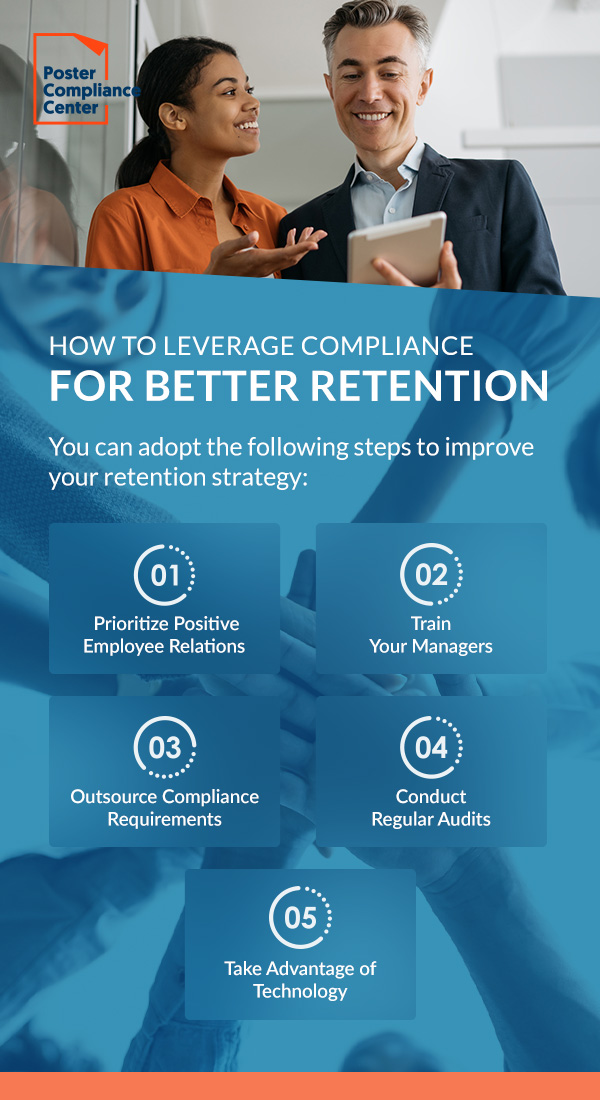
Because labor law compliance and employee retention affect each other, you can adopt the following steps to improve your retention strategy:
1. Prioritize Positive Employee Relations
Your managers must create positive employee relationships that build morale and loyalty. They should communicate your commitment to protecting employees’ rights and must prove it by their actions. Although labor law posters inform employees of their rights, managers should also actively communicate and ensure that employees understand them. Leaders must also have the conflict management skills to resolve problems as they arise before they lead to potential litigation.
For instance, managers should actively listen to their employees’ concerns, ask questions, and reflect on what the employees share. They should also encourage employee feedback to help improve their processes.
2. Train Your Managers
Managers enforce workplace policies and must receive training to reduce potential legal issues. As an HR leader, you should train your managers on employment laws, which involve:
- Wage and hour requirements
- Workplace safety
- Equal employment opportunities
- Family and medical leave
- Antiharassment policies
For instance, managers must understand what counts as work time, including travel time, on call hours and training periods. They should also know how to enforce compliant breaks and handle paid time off requests. Certain legislations, like California’s reform on the Private Attorneys General Act (PAGA), reduce penalties if your company demonstrates you’ve taken reasonable steps for labor law compliance.
3. Outsource Compliance Requirements
Automating and outsourcing labor law compliance processes reduces your HR team’s administrative tasks. This enables you to focus on more strategic initiatives while ensuring compliance and reducing human error. For instance, corporate businesses can opt for a customized, multistate poster compliance solution that makes workplace poster compliance easier. Other processes you can outsource include:
- Employee management and training
- Payroll administration
- Benefits administration
- Workplace safety
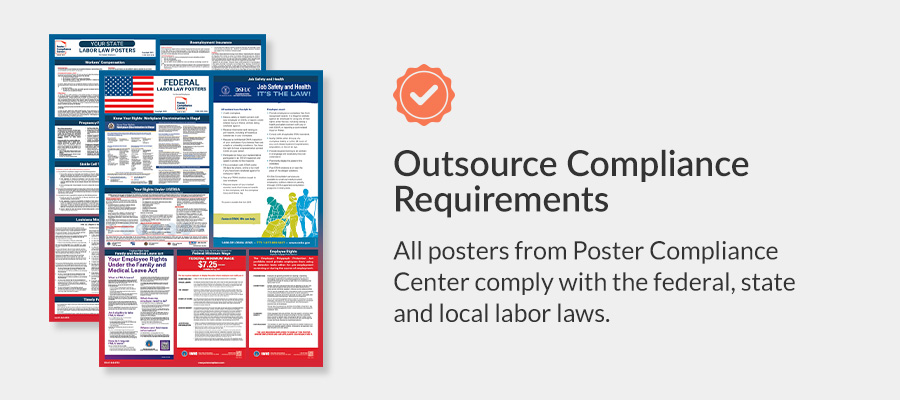
Outsourcing also lets you access other experts and technologies that offer savings on your operational costs. A trusted third-party provider, like Poster Compliance Center, ensures you get the appropriate legal oversight. For instance, all posters from Poster Compliance Center comply with the federal, state and local labor laws. You also get a warranty for potential violations if you opt for a subscription plan.
4. Conduct Regular Audits
Because you’re building employee trust through compliance, your company must conduct regular audits demonstrating your commitment to protecting employees’ rights. The DOL lists several self-audit programs to help assess your federal labor law compliance:
- Occupational Safety and Health Administration (OSHA): OSHA offers Voluntary Protection Programs that let you run self-evaluations to reduce injury rates. You can also opt for the free On-Site Consultation Program that offers confidential safety and health services for small to midsized businesses.
- Wage and Hour Division: Through the Payroll Audit Independent Determination program, you can identify and resolve minimum wage, leave and overtime violations under the FLSA and FMLA.
- Employee Benefits Security Administration (EBSA): EBSA offers the Voluntary Fiduciary Correction Program, which allows you to correct violations against the Employee Retirement Income Security Act (ERISA). You can also opt for the Delinquent Filer Voluntary Compliance Program to help you comply with ERISA’s reporting requirements.
- Office of Labor-Management Standards (OLMS): OLMS manages a Voluntary Compliance Partnership program for unions, helping them comply with the Labor-Management Reporting and Disclosure Act.
- Veterans’ Employment and Training Service (VETS): Support and Assistance for Leaders in USERRA Training and Employment (SALUTE) helps employers comply with the policies of the Uniformed Services Employment and Reemployment Rights Act (USERRA).
- Mine Safety and Health Administration (MSHA): Through MSHA’s Compliance Assistance in Safety and Health program, you can access safety and health resources for mining operations, while accessing direct contact to safety and health specialists for compliance assistance.
You still need to account for state and local labor laws. Poster Compliance Center offers poster compliance plans to help you smoothly complete relevant audits.
5. Take Advantage of Technology
Technology makes compliance easier by improving your processes and reducing human error. It also lets you comply with labor law requirements for remote and hybrid employees. For instance, Poster Compliance Center offers eComply360 to supplement your physical workplace posters with digital versions. It’s a centralized hub that updates your management and remote teams on their rights and regulation changes 24/7.
Additionally, compliance tracking tools help you ensure compliance in multiple locations. For instance, advanced payroll systems manage complex payroll and tax rules for you, which vary per state. While California requires a $16.50 minimum wage for most employers, Texas mandates $7.25 per hour. The technology you adopt ideally integrates into your existing IT infrastructure for a smoother workflow.
Improve Employee Retention With Poster Compliance Center
The link between compliance and employee turnover is evident. Instead of operating from a reactive standpoint, your company must proactively adhere to relevant labor laws to avoid costly turnover and potential lawsuits. Retaining employees requires building trust and improving employee morale and engagement. Opting for third-party services and tools is a good way to improve your strategy.
Poster Compliance Center is your dedicated compliance partner who can help you comply with all relevant workplace poster laws — federal, state and local regulations. We also offer customized solutions for any business, whether you’re a small business or a corporate organization with over 30 locations across the country.
We offer fast turnaround for every shipment. Plus, you get free shipments for poster updates if you opt for one of our subscription plans. Our eComply360 also notifies you of any changes. You won’t need to regularly check government websites for regulation changes. If you’re ready to get started, contact our labor law experts today.