
On October 8, 2025, California Governor Gavin Newsom signed Senate Bill 642, or SB 642. It refined the state’s pay transparency law, effective 2026. The changes clarified the pay scale and wage definitions and expanded liability periods. The bill amended California’s Equal Pay Act, offering a clearer perspective on what constitutes a violation.
SB 642 complements SB 464, which modified California’s pay data reporting requirements. Understanding the major changes is essential to staying on top of compliance. You must also adapt your recruitment and compliance strategies to navigate the new laws. Learning the common mistakes and how to avoid them should also help.
In This Article
- How SB 642 Improved Pay Transparency Requirements
- Who Must Comply
- SB 642 vs. SB 464: California’s Pay Data Reporting Changes
- How to Comply With the New Laws
- Common Compliance Mistakes to Avoid
How SB 642 Improved Pay Transparency Requirements
California’s pay transparency requirements fall under the Labor Code §432.3. The labor code prohibits asking about salary history and requires providing a pay scale on job ads and upon request. However, some job postings used wide and imprecise ranges. These ranges look more like a lifetime potential than a realistic offer. SB 642 addresses this concern by redefining the pay scale for transparency, defining what constitutes wages and streamlining the window period for filing claims.
The New “Upon Hire” Standard
The pay scale in California should be a good-faith estimate of the salary or hourly wage you expect to pay upon hiring. You can post this day-one compensation as a range. However, the range must mirror your hiring budget, instead of the highest pay a role can receive over time. Failing to include pay scales can result in civil penalties ranging from $100 to $10,000 per violation.
Pay scale disclosures also apply to remote work and nationwide listings if the job can be performed in California or by a California resident. These job ads must still include the upon-hire or day-one compensation. To avoid this disclosure requirement, you must indicate that the role is not available to California residents. However, excluding these residents can limit your talent pool.
Statute of Limitations and Lookback Periods
SB 642 expands the filing window to three years for equal pay claims. Previously, employees had two years to file a claim for regular violations and three years for willful violations. Streamlining the timeline removes the need to prove an employer’s willfulness. If violations occur, employees can recover up to six years of lost wages, plus interest and potential damages.
What Counts as Wages
The Equal Pay Act previously did not define wages. With SB 642, the law clarifies that wages and wage rates encompass total compensation instead of base pay. These include:
- Base salary or hourly wages.
- Overtime pay.
- Incentive compensation, such as annual or sales bonuses.
- Commissions and piece rate compensation.
- Equity and long-term incentives, including stock, stock options and restricted stock units (RSUs).
- Profit sharing and other plan-based awards.
- Allowances and reimbursements, such as gasoline allowances and travel reimbursements.
- Paid time elements or benefits that function as compensation components.
The expanded wage definition doesn’t impact job posting requirements. However, failing to consider the total compensation can lead to Equal Pay Act violations. Under the Act, employees can compare full packages for similar work, which are jobs with comparable skills, effort, responsibility and working conditions. Positions with the same base pay but significantly different wages can lead to equal pay claims.
Inclusive Gender Protections
SB 642 updates the Equal Pay Act’s wording from “opposite sex” to “another sex.” This change confirms that equal pay protections apply to all genders, including nonbinary and gender-diverse employees. The update removes ambiguity when comparing pay across your workforce. It also aligns with California’s broader anti-discrimination framework.
Who Must Comply
Employers with at least 15 employees, where at least one of them resides or works in California, must include pay scales in job postings and provide them upon request. However, all employers, regardless of size, must comply with the Equal Pay Act’s total-compensation analysis.

SB 642 vs. SB 464: California’s Pay Data Reporting Changes
SB 642 works in tandem with SB 464, which updates California’s pay data reporting requirements. Effective January 1, 2026, SB 464 requires employers with over 100 employees to store demographic data separately from personnel files.
Starting with the 2027 reporting cycle, employers must classify workers using 23 federal Standard Occupational Classification (SOC) categories. While SB 642 focuses on pay transparency, SB 464 ensures the California Civil Rights Department (CRD) has granular data to identify systemic pay gaps.
Reports go directly to CRD’s Equal Pay and Anti-Discrimination Unit — the same division that investigates discrimination complaints and enforces equal pay laws. The CRD uses the aggregated data to identify industries, occupations or employers with potential pay disparities, which can trigger further investigation.
How the SOC Category Transition Affects Job Postings
The shift to 23 SOC categories requires more detailed job classification. For example, the current Professionals category lumps together accountants, engineers, nurses and lawyers. Under SOC, each occupation gets its own category. You’ll need to:
- Review every job title and description to assign the correct SOC code.
- Train HR staff on SOC classification methodology.
- Update your human resources information system (HRIS) to capture and store SOC codes.
- Reconcile SOC classifications with your internal job architecture.
This transition takes time. It’s best to start mapping your current roles to SOC categories now, before the 2027 reporting cycle begins. The Bureau of Labor Statistics publishes the SOC manual and crosswalks to help with classification.
Filing Deadlines and Process
You must submit your pay data report to CRD on or before the second Wednesday of May each year. The CRD provides an online portal where you upload your report in the required format. You’ll need to include employee counts, pay bands, hours worked, race, ethnicity and sex data broken down by establishment and job category. Missing the May deadline triggers enforcement action.
The CRD can request the report directly. If you fail to respond or submit an incomplete report, the CRD may refer your case for civil penalties. Previously, penalties were discretionary — the CRD could choose whether to pursue them. SB 464 makes penalties mandatory for noncompliance, raising the stakes significantly.
Penalties for Noncompliance
Courts can now impose civil penalties if the CRD requests them. While this can be costly, noncompliance also creates a public record of your organization’s failure to meet transparency standards. This record can damage your reputation with candidates, employees and investors.
How to Comply With the New Laws
Noncompliance impacts your competitive advantage, apart from resulting in costly repercussions. You can adapt to the law changes by updating your compliance strategies. Here’s how:
1. Update Active Postings With Good-Faith Estimates
Every California posting must include an upon-hire range that matches your budget. Replace legacy ranges tied to position-wide bands or lifetime potential. Using market benchmarks, calibrate ranges by job and location. If there are exceptions, establish clear rules for these exceptions and how you shall grant them.
For instance, you might offer a salary higher than your posted range due to the candidate’s experience. You need legitimate business reasons for these exceptions and must document every approved exception to mitigate risks. Also, update your agreements with recruiting firms and job boards. The pay range must be visible in the posting itself, not hiding behind a link or QR code.
For roles with highly variable pay, such as sales, keep the posted range tighter and explain compensation in conversations. Tighter ranges can demonstrate realistic hiring intent. California has not set a limit for a good-faith estimate. However, a broad, $50,000-$200,000 range for a single role would likely fail a good-faith test.
2. Clearly Document Total Compensation

Clear records show that pay differences are tied to business reasons, instead of protected characteristics. If you provide different pay for similar positions, document potential reasons, such as education, experience and performance. When offering bonuses, commissions or other variable pay, write down your decision factors, too. For instance, your factors may include sales territory size, performance goals met or equity award levels.
Also, keep detailed records of stock grants, option awards and vesting timelines. Save the whole history of each award so you can explain compensation differences. If your pay differs per location, document your pay adjustment schedule and your explanations for why these location differences exist.
For an effective compliance system, decide in advance when and how you’ll:
- Make pay adjustments during the year.
- Update salary structures.
- Communicate changes to employees.
Keep records that show you looked for pay gaps, investigated them and fixed problems when needed. Save these documents long enough to cover the six-year lookback period. Essential records include:
- Job descriptions and level definitions.
- Market salary data sources and dates.
- Written justifications for pay decisions and exceptions.
- Performance evaluations used in pay decisions.
- Bonus, commission and equity eligibility rules.
- Offer letters and pay change documentation.
- Internal pay equity audit results and remediation plans.
3. Create Consistent Recruiter Materials
Pay ranges should be the same across job templates, recruiter scripts, intake forms and offer letters. Third parties that advertise your roles should use the same pay range. Multistate postings should show California-compliant ranges if a job can be fulfilled by a resident. If you use a central requisition library, create a California-compliant version of the job ad and ensure California audiences can see the applicable version.
Even when you use staffing agencies or job boards, you remain responsible for ensuring the pay scale appears in the posting. Your vendor contracts should require compliant postings and conduct spot-checks. Under Labor Code 432.3, liability rests with the employer, not the third party.
4. Update Recruiter Playbooks
Train your recruiters on how and when to:
- Discuss pay legally.
- Respond when candidates or employees ask for pay information.
- Loop in your compensation team or legal counsel.
Your recruiters need to understand how much flexibility they have — for instance, 5%-10% above or below the midpoint — and who can approve pay outside the standard range. If exceptions apply, require a written justification.
Apart from applicants, employees can also request the pay scale for their position at any time. Remember to stick to the good-faith estimate. Document requests and responses to show you met the disclosure obligation.
5. Strategize for Multistate Complexities
If your company operates in multiple states, California’s rules create compliance complexity. For instance, if you’re headquartered in a state without pay transparency requirements, your default job postings might not include pay ranges. You might then create separate postings for California-based roles.
You might even choose to have location-specific ranges, such as postings for the San Francisco Bay Area or Sacramento. You can justify amount differences through geographic differentials, such as the cost of labor indices or market data by metro area. However, some employers resort to using the most restrictive state requirements. Applying these requirements to all job postings removes the patchwork approach, simplifies administration and reduces the risk of posting the wrong job ad to the wrong audience.
6. Work With Compliance Partners
Managing multiple locations or distributed workforces can be complex. However, compliance partners can reduce the administrative burden. Corporate compliance programs monitor mandatory changes and manage poster updates across locations. A dedicated account manager can also coordinate shipments and answer your questions.
Annual or multiyear compliance plans send free updates whenever laws change. These plans are also often backed by a compliance guarantee. Digital platforms let remote and hybrid employees access required notices anytime. Working with a compliance partner, like Poster Compliance Center, can help you and your employees stay on top of the changing labor laws.
Common Compliance Mistakes to Avoid
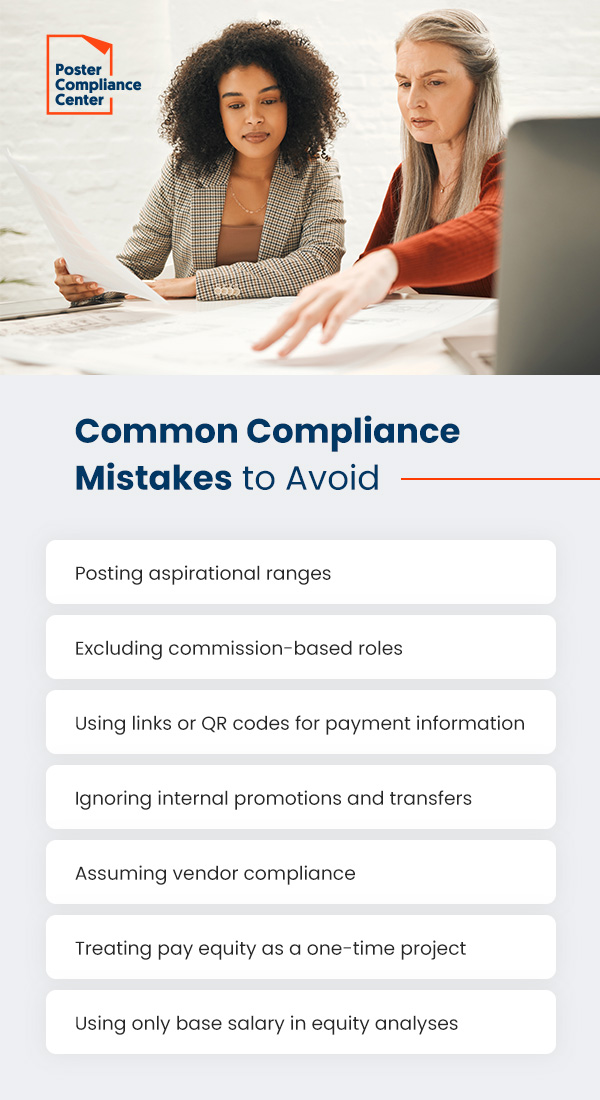
California’s SB 642 amends pay transparency requirements, which impact your compliance with the Equal Pay Act. To smoothly adjust to the new law, consider these common mistakes and how you can avoid them:
- Posting aspirational ranges: List what you’d pay a new hire instead of what a top performer can earn years into the role.
- Excluding commission-based roles: If compensation is primarily commission, you must still disclose the pay scale. Clearly state if pay is by commission only and provide the payment structure or expected range.
- Using links or QR codes for payment information: According to the Labor Commissioner, pay scales must appear in the posting text itself.
- Ignoring internal promotions and transfers: The law requires disclosing pay scales when current employees request it for their own position or for roles they’re considering internally.
- Assuming vendor compliance: Audit third-party postings regularly.
- Treating pay equity as a one-time project: With a six-year lookback, ongoing pay disparities compound. Schedule annual reviews and document remediation efforts to avoid issues.
- Using only base salary in equity analyses: Beyond base pay, examine the total compensation package you offer, including bonuses, equity allowances and benefits.
Navigate Pay Transparency Laws With Poster Compliance Center
SB 642 updated the salary disclosure requirements in California, which significantly improved pay transparency. The law now includes the “upon hire” pay scale rule, longer lookback periods for wage claims and total-compensation pay equity requirements. To navigate these complexities, develop a compliant system that adapts to the changing regulations. Poster Compliance Center can be just the compliance partner you need.
We have been helping organizations stay compliant with federal, state and local labor law poster requirements since 1991. With our customized corporate solutions, you can be confident that your workplace locations display the current, accurate mandatory workplace posters. Our solutions ensure your company complies with mandatory poster requirements. Your employees can also stay informed about their rights through the different posters.
Remote and hybrid teams can take advantage of our digital platform, eComply360. Small to medium-sized businesses may benefit from our annual compliance plans. Whatever the scale of your business, our custom solutions can help you. Review your options today to get started.