Staying compliant with labor laws requires continuous work. Regulatory updates are hard to predict, and changes happen at the federal, state and local levels. With the many policies involved, HR professionals need an effective way to stay on top of compliance. Otherwise, you risk costly fines, lawsuits and a loss of employee or customer trust.
An HR compliance checklist should make the process easier. This article breaks down some of the labor law and poster changes that occurred this past year, which you can incorporate into your annual HR compliance review.
In this Article:
- Major Federal Poster Updates: The National Baseline
- Key State and Local Poster Updates
- Top 3 Legislative Trends Affecting HR Compliance
- Looking Ahead: What to Watch for in the Coming Year
- Frequently Asked Questions
Major Federal Poster Updates: The National Baseline
In 2025, only the “Federal Minimum Wage for Contractors” poster has been updated, but the latest mandatory changes to the “Know Your Rights: Workplace Discrimination Is Illegal” poster are also worth noting. Here are the changes:
1. Federal Minimum Wage for Contractors Poster Updates
The “Federal Minimum Wage for Contractors” poster has an updated minimum wage requirement for 2025, which is $13.30 per hour. On March 14, 2025, President Trump revoked the 2021 Executive Order (E.O.) 14026, which increased the minimum wage to $15.00.
The “Pay Transparency Nondiscrimination” notice was also removed from the poster. E.O. 13665, titled “Non-Retaliation for Disclosure of Compensation Information,” amended E.O. 11246 of 1965, which led to the notice requirement. However, the recent E.O. 14173, titled “Ending Illegal Discrimination and Restoring Merit-Based Opportunity,” revoked E.O. 11246.
The changing regulations easily impact poster requirements. Obtaining the new federal labor law posters for contractors can protect you from the risk of noncompliance.
2. Know Your Rights: Workplace Discrimination Is Illegal Poster Updates
The “Know Your Rights: Workplace Discrimination Is Illegal” poster describes the prohibition on job discrimination based on protected characteristics, like race, color and sex, including pregnancy, or employee retaliation for opposing such discrimination and related activities. Although the government mentioned that the poster may be updated soon, the latest mandatory changes happened in 2023, thanks to the Pregnant Workers Fairness Act (PWFA), enforced by the Equal Employment Opportunity Commission (EEOC).
The PWFA poster update requires companies to offer reasonable accommodation to employees due to pregnancy, childbirth or related conditions, as long as it does not cause “undue hardship.” The poster update applies to public sector and private employers with 15 or more employees, federal agencies, Congress, employment agencies, and labor organizations.
Although over 30 states and cities also have accommodation laws for pregnant employees, PWFA is a separate legislation. Title VII of the Civil Rights Act of 1964 penalizes employers who fail to post the required notices. The amount is adjusted annually for inflation, which is $680 in 2025.

Key State and Local Poster Updates
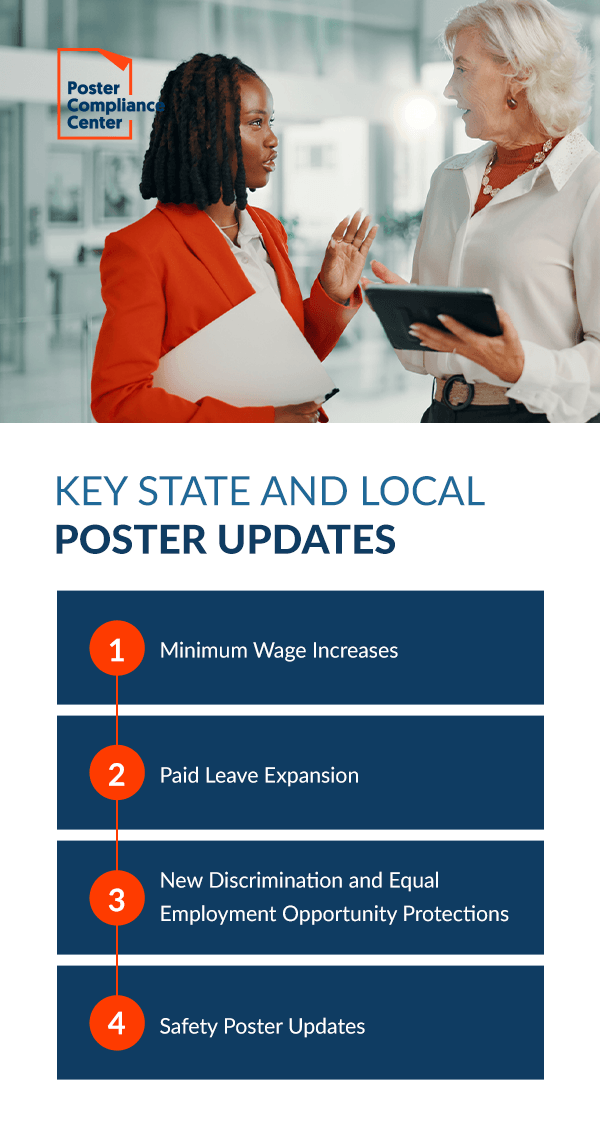
Aside from monitoring federal labor laws, you should also stay on top of any state and city labor law poster changes to ensure labor law compliance. Local poster updates can be more challenging to manage, especially if your company operates in multiple locations. An annual HR compliance review is an ideal opportunity to navigate these changes, or you can work with us to implement a state and federal compliance plan to keep your business up to date year-round.
1. Minimum Wage Increases
 The state minimum wage poster updates in 2025 show increased minimum wages. For instance, Alaska increased its rate from $11.91 to $13.00 per hour. Arizona increased its rate from $14.35 to $14.70 per hour and will increase again to $15.15 per hour in 2026. Cities and counties may have their own requirements. For instance, in Flagstaff, Arizona, the minimum wage is $17.85 in 2025 and will increase to $18.35 in 2026.
These changes usually account for cost-of-living increases. In case of conflict, the employer shall follow the minimum wage law that benefits employees the most. For instance, if the state minimum wage is higher than the federal minimum wage, then the state law supersedes the federal law.
As of 2025, 13 states have a minimum wage rate equal to the federal minimum, while seven states do not have separate minimum wage requirements, meaning they also follow the federal minimum wage.
2. Paid Leave Expansion
New paid leave laws require updates to your workplace notices. Examples of states with paid leave changes include:
- Alaska: Paid sick leave took effect on July 1, 2025.
- Delaware: Paid leave contributions began on January 1, 2025, but the leave will take full effect on January 1, 2026. The new law applies to companies with 10 or more employees.
- Michigan: For companies with 10 or more employees, paid sick leave took effect on February 21, 2025. For companies with 10 or fewer employees, which are considered small businesses, paid sick leave requirements took effect on October 1, 2025.
- Minnesota: Minnesota has set December 2025 as the deadline for companies to notify employees about their paid leave benefits, which will take effect in January 2026.
- Nebraska: The new paid sick time law took effect on October 1, 2025, which applies to companies with 11 or more employees.
Note that paid leave is different from paid family and medical leave (PFML). While paid leave offers payment and job protections for employees who need to care for their health or family, state PFML requires states, instead of the employer, to offer wage replacements for employees who need time for:
- Caring for their own or their family member’s health.
- Bonding with a new child.
- Supporting family members on active military duty.
Staying up to date with these paid leave law trends helps you remain compliant. Our labor law updates can help you stay informed about the most recent changes in your state.
3. New Discrimination and Equal Employment Opportunity (EEO) Protections
Some states have updated their policies regarding anti-discrimination and benefits. For instance, Arkansas requires employers with 50 or more employees to display the new Veterans’ Benefits and Services notice. The poster contains resources helpful for veterans, including:
- Workforce and training resources
- Tax benefit programs
- Substance abuse and mental health programs
- Legal services
Connecticut also updated its “Discrimination is Illegal” poster, stating that discrimination due to the following is illegal:
- Alienage
- Domestic abuse victim status
- Criminal conviction
- Erased criminal history
Connecticut’s updated poster also elaborates on the definition of “disability,” highlighting that physical disabilities include, but are not limited to:
- Blindness
- Deafness
- Mobility impairments
- Using a guide dog
4. Safety Poster Updates
Although the “Job Safety and Health: It’s the Law Workplace Poster” has no mandatory poster changes at the federal level, some states have updated their Occupational Safety and Health Administration (OSHA) posters. Examples include:
- Alaska: Alaska’s “Safety and Health Protection on the Job” poster raised its mandatory penalty amount to $16,550 per serious violation, and up to the same amount for other violations. This amount can be charged per day for failing to correct violations. Employers who willfully and repeatedly violate the law can be penalized up to $165,514.00 per violation.
- Maryland: Maryland’s “Safety and Health Protection on the Job” poster updated the maximum penalty to $16,550 per OSHA violation, and charges the same penalty per day for uncorrected violations. Willful and repeated violations will result in a cost of $161,323, with a minimum civil penalty of $16,550.
- Kentucky: The same poster from Kentucky states that employers need to report work-related accidents resulting in hospitalization, amputation or loss of an eye to the Division of Occupational Safety and Health Compliance within 24 hours.
- Indiana: Indiana mandates a new notice, called “Work Restrictions for Youth Employees”, which prohibits employees below 18 from working in hazardous occupations, as designated by the FLSA. It also removes the working hour restrictions for workers aged 16 and 17.
Top 3 Legislative Trends Affecting HR Compliance
To effectively navigate HR compliance challenges, you need to understand the legislative trends and the reasons they come about. The following summarizes the poster updates this past year and how you can adapt your work policies to cater to the changes:
1. Rise of Pay Transparency
While compensation has traditionally been kept undisclosed, several regulations now require employers to display salary ranges in job advertisements and prohibit them from asking questions regarding salary history. This increasing demand for pay transparency presents opportunities for companies to gain the trust of applicants and employees, which is essential for a healthy workplace relationship. It also holds companies accountable with relevant wage laws and challenges employers to remain competitive.
A pay transparency analysis revealed that 42% of organizations operate in a location where pay range transparency is required in job postings. When not mandated by law, 67% list the starting pay either sometimes, often or always.
Maryland became the first state to require employers to provide salary ranges for open positions upon request in 2020. Colorado followed by requiring employers to post the salary ranges publicly in 2021. Today, many states have followed through in requiring such disclosures, including Connecticut, Nevada, Rhode Island and California. Other states are still considering the requirement.
2. Expansion of Paid Family and Medical Leave
Multiple states and the District of Columbia have legislation for mandatory PFML. This leave provides cash benefits to eligible employees engaging in specific caregiving activities. Under these programs, employees can receive 12 to 52 weeks of total benefits in a single benefit year. While no federal law currently mandates PFML, proposals like the Build Back Better Act (BBBA) may offer the benefit.
3. Increased Protection for Vulnerable Workers
Regulatory updates from the PWFA and state-level mandates related to discrimination and safety show an increasing protection for vulnerable workers across industries. While compliance is essential, reviewing and adjusting your work policies to cater to your employees’ needs ensures that everyone can work at their optimum level, contributing to the company’s long-term success.
Looking Ahead: What to Watch for in the Coming Year
The evolving employee needs and mandates shape future HR legislation. As a forward-thinking company, consider the following, which can impact upcoming labor laws:
- Paid leave programs: More states have been adopting paid leave programs, such as Nebraska, which adopted a new law in late 2025, and Delaware, which has a law taking effect in 2026. These laws are also subject to change. For instance, Michigan made some last-minute changes to its paid leave program, necessitating back-to-back poster updates, and Missouri passed an Earned Sick Time law only to repeal the policy later on.
- Captive audience laws: Captive audience laws prohibit companies from requiring employees to attend religious, political and union-related meetings where the employer discusses their own views. More states have been adopting such laws, including New Jersey, which is set to require a Captive Audience notice in December 2025.
- Veterans’ Benefits and Services posters: More states, like Arkansas, are requiring this poster, which includes information on veteran resources. Pennsylvania just released one for changes effective in January 2026.
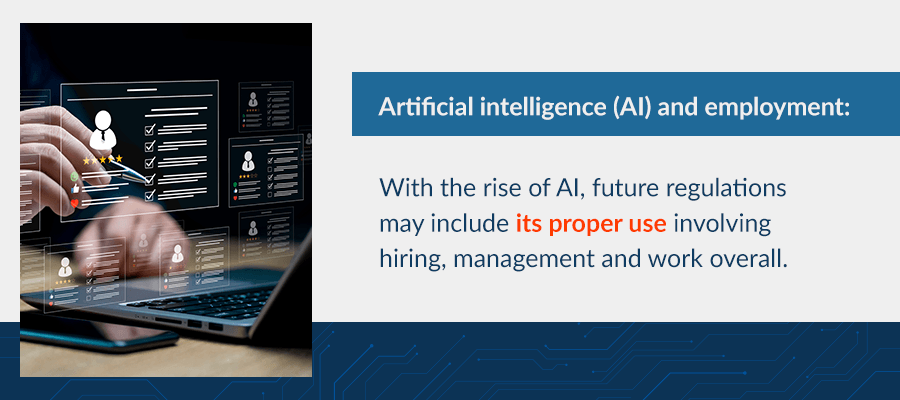
- Artificial intelligence (AI) and employment: With the rise of AI, future regulations may include its proper use involving hiring, management and work overall. For instance, the California Civil Rights Council announced its final approval of regulations prohibiting discrimination in the use of AI and similar automated decision systems. These regulations clarify how existing anti-discrimination laws apply to the new technology.
- Predictive scheduling: States and cities are considering laws that regulate scheduling for specific industries. These changes affect wage and hour compliance laws, but requirements vary per jurisdiction.
- Continued federal rulemaking: Regulatory bodies such as the DOL and EEOC may continue to add or update regulations that impact your compliance. While monitoring local labor law changes can be helpful, working with a poster compliance partner, such as Poster Compliance Center, can make your compliance process more efficient.
Frequently Asked Questions
Integrating labor law updates into your annual compliance review protects you from penalties. The following questions and answers can help you shape your auditing process:
How often do you need to update labor law posters?
You need to update your labor law posters as soon as mandatory changes are made. Working with a poster compliance partner, such as Poster Compliance Center, can help you easily navigate these changes. Poster Compliance Center monitors labor law updates to stay on top of these updates. Through our subscription plan, you’ll receive notification of any changes and will receive the updated posters as soon as possible.
What is the financial risk of having outdated posters?
Noncompliance with poster requirements includes penalties, employee complaints and audits. It can also result in indirect costs, such as legal fees, additional operating costs, productivity loss and back pay. The reputational issues that arise from damaged employee trust and public litigation can also have a lasting impact on your company.
Does your business need both federal and state posters?
Your business needs federal, state, local and industry-required posters. These should be displayed in conspicuous places where your employees can read them easily. Your remote or hybrid workers should also be able to access digital poster requirements to remain compliant. Failure to display these notices may result in penalties, depending on the specific poster.
How do you conduct an HR compliance audit for posters?
Integrating compliance into your risk management strategy makes the auditing process easier and ensures you have a streamlined process for identifying the required posters. To conduct an audit, you need to assess the likelihood of noncompliance risks and their potential impact on your company. Automated compliance solutions also offer a systematic monitoring and documentation process, which makes auditing more efficient.
Ensure Year-Round Compliance With Poster Compliance Center
When thinking about how to stay compliant with labor laws, consider leveraging a labor law poster subscription service like Poster Compliance Center. Our annual subscription services ensure you receive the most up-to-date mandatory posters, protecting you from risks such as fines and reputational damage. Whether you’re a small business or a large corporation, we have the right compliance solutions you need. Our digital compliance platform also ensures your remote and hybrid workers know about their rights from any location. Request a custom quote today to get started.