

HR leaders managing construction crews face a compliance problem they can’t solve with a bulletin board. Your workers move between jobsites and operate from trailers or trucks, and subcontractors regularly join projects mid-stream. This operating style, coupled with compliance obligations that change with each jurisdiction, makes complying with labor poster laws challenging. Even when you do achieve compliance, documenting proof of this becomes an operational headache that demands effective corporate compliance solutions that use both strategy and practical tools.
The solution to these problems pairs physical methods with digital platforms so that every worker can access mandatory notices, wherever or whenever they’re working.
In This Article
- Why Poster Compliance Is a Unique Challenge in Construction
- Core Solutions for Mobile Workforce Compliance
- The Layers of Poster Requirements
- Why Is Mobile Labor Poster Law Compliance Important?
- Best Practices for Auditing Compliance on Jobsites
- Simplify Your Mobile Compliance With Poster Compliance Center
Why Poster Compliance Is a Unique Challenge in Construction
Construction companies face compliance obstacles that many office-based businesses never encounter, such as:
- Temporary and remote locations: Mobile construction workers regularly operate from jobsites that exist for weeks or months and trailers that relocate. As a result, there’s rarely a permanent breakroom to post notices in, as is typical in a permanent working environment.
- Constant crew movement: Workers shift between projects and worksites daily or weekly, each with different local requirements.
- Mixed workforce composition: Full-time employees work alongside subcontractors and temporary labor. These various employment relationships can create additional long-term compliance challenges.
- Jurisdictional complexity: Operating across state lines means complying with federal requirements plus the specific mandates of every state, city and county where work occurs.
Core Solutions for Mobile Workforce Compliance
To overcome the compliance challenges that come with mobile construction workers, you need a strategy that combines physical methods with modern digital tools. Your strategy also requires flexibility without sacrificing the standards of traditional posting requirements.
Federal regulations require employers to post notices where employees can readily see them. For mobile crews, federal labor law poster regulations define this as “the location from which the employees operate to carry out their activities.” That could be a jobsite trailer, a foreman’s truck or a company car.
Regardless of where your employees work, regulations require you to provide access to either physical or digital posters.
Physical Posters
Construction environments tend to be rugged, remote and unpredictable, which often makes them unsuitable for digital devices. In these environments, paper-based systems work well.
Physical posters printed on poly paper offer a durable, simple and compliant solution that can be stored or displayed in an accessible location, such as a site trailer. All the necessary federal and state notices can also be made available in the same location, ready for inspection at any time. Poster Compliance Center can ensure you have whichever physical posters you need, regardless of your industry or location in the U.S.
Digital Posters
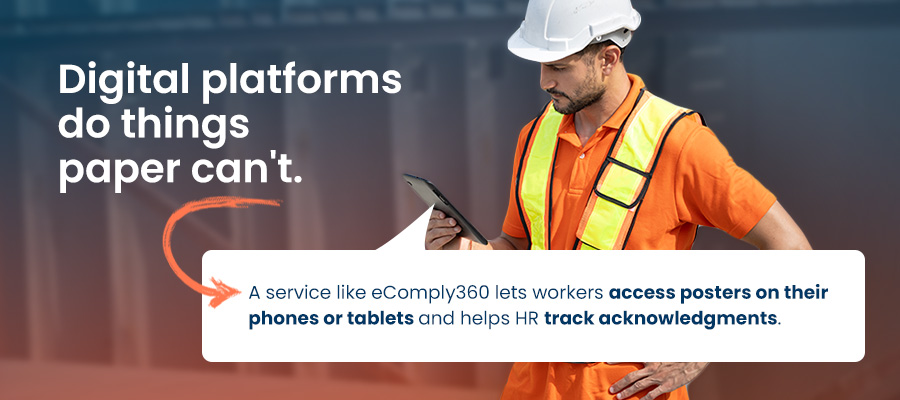
Digital platforms do things paper can’t. A service like eComply360 lets workers access posters on their phones or tablets and helps HR track acknowledgments, which matters during audits.
The U.S. Department of Labor (DOL) allows some electronic posting, but it has to work as well as a hard copy, meaning employees must be able to find and review notices without asking permission.
The right digital solutions can also give you instant updates when laws change and document which employees accessed which notices and when. For businesses operating across multiple sites, digital solutions can minimize compliance costs, since they scale across hundreds of sites without shipping costs. For HR teams managing compliance across multiple states, these benefits translate to lower risk and better efficiency.
The Layers of Poster Requirements
All employers must display posters to comply with:
- Federal requirements: U.S. employers generally must post notices covering minimum wage standards, workplace safety, antidiscrimination protections, and family and medical leave.
- State requirements: Each state adds its own mandatory notices for workers’ compensation, state-specific minimum wages, paid sick leave and unemployment insurance. States with stronger labor protections, such as California, New York and Washington, typically require more postings.
- Local requirements: Cities and counties can add notice requirements for paid sick leave, minimum wage ordinances and fair scheduling laws.
Construction companies working across multiple jurisdictions face real complexity in tracking which posters belong at each jobsite. The DOL covers federal poster requirements, but coordinating local mandates takes specialized knowledge. An expert provider like Poster Compliance Center knows which state, city and county poster requirements apply to your business and can help you comply with all of them.
Why Is Mobile Labor Poster Law Compliance Important?
Noncompliance creates problems that can disrupt your operations and expose your organization to legal risk. Noncompliance consequences can include:
- Government fines: Federal and state agencies issue penalties for failure to display required notices. OSHA violations can cost hundreds to thousands of dollars per missing poster, with repeat violations carrying bigger penalties.
- Legal liability in employee lawsuits: Employees who don’t know their rights because the required notices weren’t posted may have stronger claims in wrongful termination, injury compensation, discrimination or wage disputes.
- Project delays during audits: If a regulatory inspection finds your jobsite out of compliance, the paperwork, remediation requirements and potential stop-work orders can delay project timelines and damage relationships with general contractors or clients.
Best Practices for Auditing Compliance on Jobsites
HR leaders can strengthen mobile workforce compliance by putting systematic self-audit practices in place:
- Designate a site-specific compliance lead: Give responsibility to an on-site foreman or site supervisor to maintain poster access and verify that all workers know where to find required notices.
- Conduct regular spot-checks: Schedule quarterly reviews of physical posters and digital access logs. Check that posters reflect current laws and that digital platforms work correctly.
- Maintain a central record: Keep a master log showing which posters are displayed at which sites, when they were last updated and which jurisdictions apply.
- Document worker access: Use sign-in sheets for physical posters or system logs for digital platforms to prove employees had the opportunity to review required notices.
Being able to prove that you’re complying with labor poster laws is just as important as complying with them in the first place. An audit-ready trail of documentation matters when regulators or legal teams request evidence of your compliance efforts.
Simplify Your Mobile Compliance With Poster Compliance Center
Managing compliance for a mobile construction workforce doesn’t have to be overwhelming. Poster Compliance Center has been helping organizations comply with labor laws since 1991, regardless of whether they’re federal, state or local laws. We’re your dedicated compliance partner, providing customized solutions that fit how your crews actually work. We include durable physical poster sets for jobsite trailers, and eComply360 service, a digital service within the Virtual Compliance Portal, gives workers instant access to mandatory notices.
Our team of compliance specialists understands the challenges construction companies face across multiple jurisdictions.
Learn more about how our corporate compliance solutions can guarantee that your mobile workforce complies with all relevant labor poster laws.