Although many human resource teams pretend it is still temporary, the shift to hybrid and remote work is here to stay. What started as a short-term solution during the pandemic has become the new norm for most organizations. However, here’s the challenge every HR leader faces — how do you comply with laws written for a physical world when your workforce is scattered across home offices, coworking spaces and traditional locations?
The situation is not just a logistics problem — it’s an opportunity to build a smarter, more effective compliance system that works for each employee. The old method of simply hanging posters in break rooms was problematic even before remote work became popular. Today, those potential problems have turned into legitimate compliance risks.
Here’s what we’ll cover to help you build a compliance strategy that fits your organization:
- Why the traditional poster-only approach creates compliance blind spots
- Requirements for both physical and digital workplaces
- The real risks of managing two separate, disconnected compliance systems
- A practical game plan for creating a unified strategy for all employees\
Contact Us with Compliance Training Questions
In this Article:
- How Hybrid Workforce Labor Law Posters Broke the Traditional Model
- Physical vs. Digital Labor Law Posters — Why Both Still Matter
- Meeting Obligations for Digital Labor Law Poster Requirements
- State Electronic Notice Laws Are Becoming More Specific
- What Makes a Digital Solution Compliant?
- The Real Cost of Managing Two Separate Systems
- A Fractured Employee Experience
- Building a Unified Compliance Strategy for Your Organization
How Hybrid Workforce Labor Law Posters Broke the Traditional Model
The compliance world still has not adapted to how many workforces operate today. Most labor laws still assume employees show up to a single location where they can read notices posted on walls. That assumption creates immediate problems for any organization with remote or hybrid workers.
The Forgotten Remote Employee
When someone works from home full-time, the poster on the break room wall at your office does not legally notify them of their rights. The law requires you to inform employees about minimum wage, overtime rules, safety procedures and dozens of other mandates. A poster they never see doesn’t meet that requirement. It’s that simple.
The situation is a direct compliance failure for a growing part of your workforce and is an issue that will increase as remote work becomes more common. While remote employees have the same rights as on-site workers, traditional posting methods leave them in the dark about those rights.
Inconsistencies for Hybrid Workers
Hybrid workers present an even trickier situation. For example, take an employee who comes to the office twice a week. They might glance at the poster one day, but what about the other three days when they work from their kitchen table at home?
This inconsistent access to required notices creates a compliance gray area. As a human resources professional, you cannot assume someone has memorized all the information during their brief office visits. The law requires consistent access to these posters — not occasional glimpses during coffee breaks once or twice a week.
Labor Laws Are Still Catching Up
Federal and state regulations are still scrambling to cover the rights of remote and hybrid workers. Some agencies have issued guidance about electronic posting, while others have not mentioned anything. A few states have created their own digital notice requirements that deviate from federal guidelines.
This patchwork of regulations makes it difficult for any single HR team to track the requirements for their organization, especially if they have multiple locations in different states. The rules change constantly and differ based on which employees work in which state. Without a reliable way to track changes, companies often discover compliance gaps after they have already fallen behind.
Physical vs. Digital Labor Law Posters — Why Both Still Matter
Before diving into the details about digital solutions, let’s be clear — physical posters aren’t going anywhere anytime soon. Despite all the talk about digital transformation, most compliance laws still require traditional posting for any location with on-site employees.
What the Current Laws Actually State
If you have even one on-site employee, you generally need physical posters in that location. It is not a suggestion or a best practice. It’s a legal requirement that has not changed despite the growing popularity of remote and hybrid work.
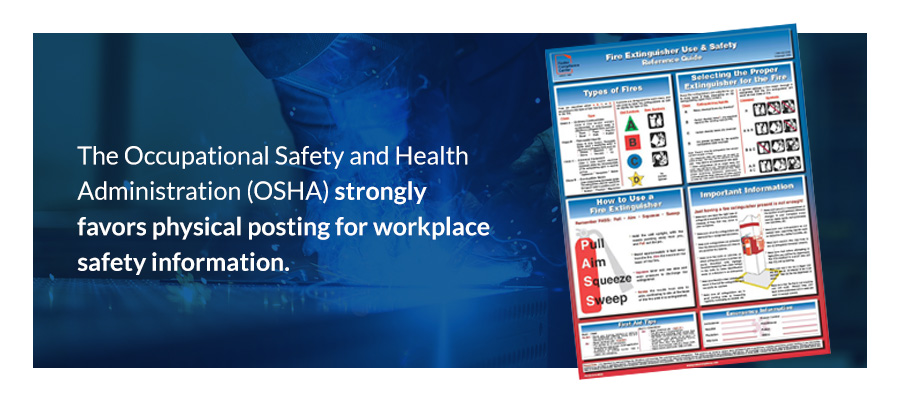
For example, the Occupational Safety and Health Administration (OSHA) strongly favors physical posting for workplace safety information. The reasoning is straightforward — safety notices must be visible to anyone who enters the workplace, whether they’re regular employees, temporary workers or visitors. Digital alternatives cannot replace that immediate, visible presence.
The Always There Advantage
Physical posters are effective because they are impossible to ignore. They don’t require logging into a system, remembering passwords or combing through email folders. They’re just there, constantly reminding employees of their rights and responsibilities.
This constant visibility is more than a matter of compliance. It signals to employees, new hires and even compliance auditors that your organization takes these regulations seriously and shows your commitment to following all the necessary labor laws.
There’s also a practical element — during emergencies or urgent situations, employees need immediate access to safety information. A poster on the wall meets those needs when digital systems might be down or inaccessible.
Meeting Obligations for Digital Labor Law Poster Requirements
Next, let’s discuss notifying remote workers about current labor laws and regulations. The process is more than just about being thorough — it involves meeting legal obligations that are becoming clearer and more specific with each passing day.
Many forward-thinking organizations understand that compliance goes beyond hanging posters. Reputable service providers like Poster Compliance Center have been helping organizations navigate these challenges and meet their digital obligations with both traditional and digital solutions.
Department of Labor Guidelines on Electronic Posting
The Department of Labor (DOL) has provided some much-needed clarity on electronic posting for remote employees. These DOL remote employee notice rules outline when and how electronic posting is acceptable. The regulations allow electronic posting for employees who work completely remotely, but with specific requirements.
Employees must have regular, reliable access to electronic notices. A human resources manager cannot just email a PDF once and consider themselves compliant. The notices must be continuously accessible through an operating system or portal that employees can reach whenever they need the information.
The DOL also requires that you clearly inform remote employees about how to access these electronic notices. You must provide instructions on where to find updates and maintain records that show each employee has received this information.
State Electronic Notice Laws Are Becoming More Specific
While several states have their own rules for electronic notice delivery, the requirements do not always align with federal guidance. Some states have detailed specifications about how businesses and organizations must deliver, track and update digital notices.
This approach is especially challenging for companies with employees in multiple states. California might have different requirements than Nevada, New York or Massachusetts, meaning a one-size-fits-all solution will likely not work for businesses with locations in more than one state. Employers must understand and comply with each state’s rules separately.
Current trends are heading toward more regulations, not less. States recognize that remote work is permanent and are creating specific rules for electronic posting. Staying ahead of these requirements means constantly monitoring the regulatory changes in all the states of your locations.
What Makes a Digital Solution Compliant?
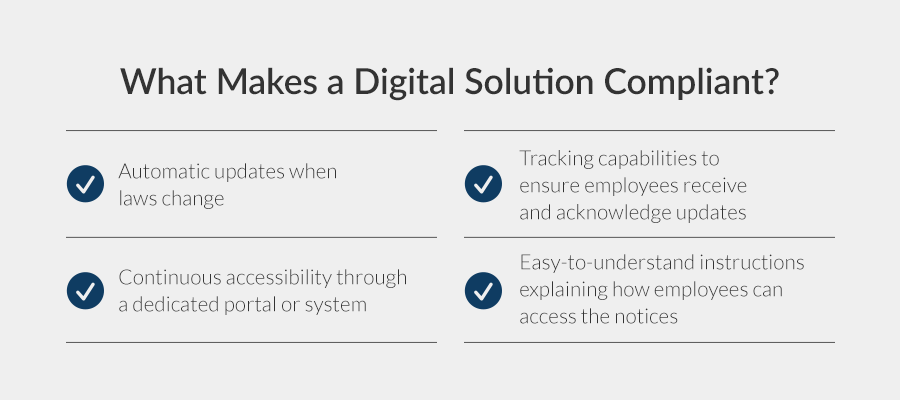
Not all digital solutions are compliant with current labor laws. Emailing employees an attachment once a year does not satisfy the accessibility requirements covered in state or federal regulations. A digital solution needs several key features for compliance, including:
- Automatic updates when laws change
- Continuous accessibility through a dedicated portal or system
- Tracking capabilities to ensure employees receive and acknowledge updates
- Easy-to-understand instructions explaining how employees can access the notices
Building and maintaining a compliant digital system requires ongoing attention to regulatory changes, technical updates and employee communication. The strict requirements mean that most do-it-yourself approaches rarely work. Instead, choose a solution like Poster Compliance Center to manage your digital posters.
The Real Cost of Managing Two Separate Systems
Many organizations have issues when they manage physical and digital compliance separately. This method often creates confusion between departments and serious compliance risks that many HR teams rarely anticipate.
When Updates Don’t Match
Picture this scenario — a mandatory update comes out for the Fair Labor Standards Act poster. Your HR team orders new physical posters and hangs them in the appropriate places in all your locations. Meanwhile, the HR staff responsible for remote and hybrid operations forgets to update the digital version.
You’re now out of compliance for your entire remote workforce, even though you thought you handled the update properly. These mismatches happen more often than expected when two different people or departments handle physical and digital updates separately.
The problem gets worse when updates happen more frequently. Labor laws often change several times per year in many states. Synchronizing two separate systems requires constant coordination between teams that might not usually work closely together.
Administrative Overload
When it comes to managing compliance for hybrid teams, administrative complexity can quickly spiral out of control. You must track different regulations, maintain two sets of records and may need to coordinate between two different departments or service providers.
For example, your vendor handling your physical facilities might mail you poster updates in March, but your digital platform isn’t updated until May. An employee calls asking about the new overtime rules they heard about, but you are not sure which version they’re referencing. Scrambling to answer their question, you pull records from different sources and hope the dates align.
You end up fielding questions about inconsistent information, explaining to employees why the poster says one thing but the digital version says something else. This confusion doubles your administrative burden without improving your compliance accuracy. When the responsibility is split between different systems, it’s easy for everyone to assume someone else is handling a particular update or requirement.
The time cost adds up quickly. Instead of one set of records or working with a single vendor, you’re managing two. Instead of one point of contact when questions arise, you’re coordinating between multiple sources.
A Fractured Employee Experience
When your physical posters state one thing but your digital platform says something different, employees notice. They start questioning whether they are receiving accurate information or if the remote workforce is somehow getting less attention than the employees at the office.
These mixed messages can damage trust in ways that go beyond complying with labor laws. Workers may wonder if the company intends to treat remote workers differently and whether all the digital compliance information is current. When employees see the correct information regardless of where they work, it reinforces the concept that everyone gets equal treatment and has access to the right updates.
Building a Unified Compliance Strategy for Your Organization
Creating a unified strategy does not require managing physical or digital compliance requirements separately. Instead, you need one provider, such as Poster Compliance Center’s Corporate Solution, that handles remote, hybrid and in-office employees. Here’s a practical three-step approach to guide you:
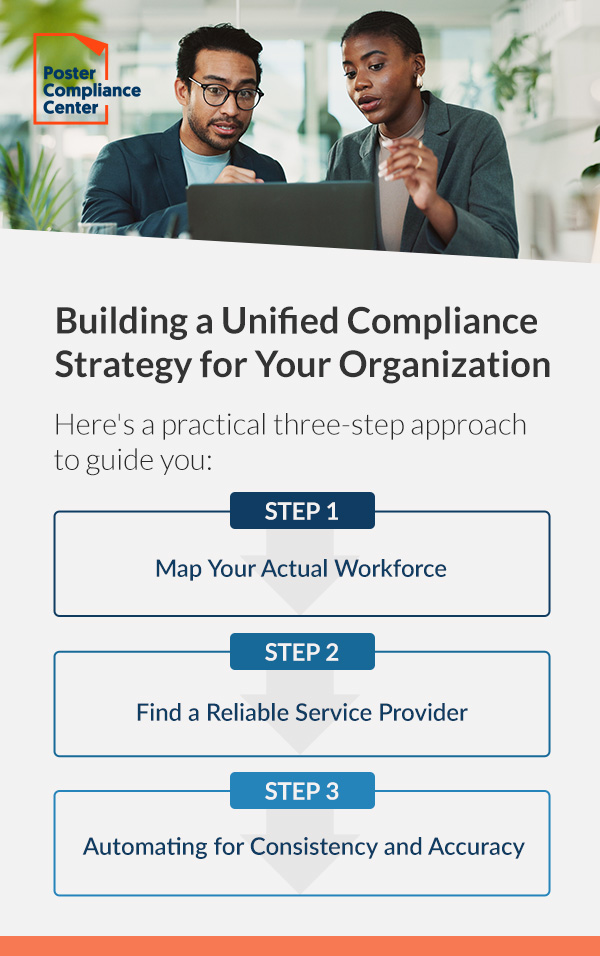
1. Map Your Actual Workforce
Before you can fix your compliance gaps, you need to know who works where. Start by categorizing every employee in your organization:
- 100% on-site workers: These workers need access to physical posters in their work location.
- 100% remote workers: These workers need quick and reliable access to digital notices.
- Hybrid workers: These workers need both physical access during on-site days and digital access during remote work.
Don’t forget about the different worker types, such as independent contractors, temporary workers or employees in satellite offices. Each group might have different compliance requirements based on their work arrangements and locations.
This critical first step often reveals compliance gaps you did not know you had. For example, you might learn you have remote employees in states without physical locations or a hybrid worker who splits time between different cities or states.
2. Find a Reliable Service Provider
Poster Compliance Center can coordinate your physical poster requirements and digital platform needs under one system. Our solutions eliminate problems that create compliance gaps when working with different vendors or spreading responsibilities across various departments.
When laws change, we send updates to your physical locations and digital platform simultaneously. You get one point of contact, one update schedule and one compliance record. We can also explain what these updates mean for your organization, allowing you to better field employee questions and concerns when they arise.
3. Automating for Consistency and Accuracy
The ultimate goal is to create a single source of truth for all your compliance requirements. When a mandatory law change happens, your system should automatically trigger updates to both physical poster shipments and digital platform content.
This automation eliminates human error and coordination problems for your HR staff. You will not have to contact multiple vendors about the same update, and you don’t have to worry about timing mismatches between physical and digital updates.
Automated systems also provide more accurate record-keeping. You get one compliance record that shows when updates were sent to all your locations and each employee group. Most importantly, this documentation is critical if you ever face a compliance audit or investigation.
The best automated systems also include proactive notifications. Instead of learning about compliance changes after the fact, you get advanced notice about upcoming requirements and automatic updates when changes take effect.
Learn More With Poster Compliance Center
A unified compliance strategy is about more than following the rules and passing audits. It’s about creating a practical system that works for each employee. It protects your organization from compliance gaps while reducing the administrative burden on your HR team.
At Poster Compliance Center, our compliance solutions for remote workers and hybrid teams ensure every employee receives up-to-date information — no matter where they work. Our experts understand traditional posting requirements and emerging digital obligations, helping you create a unified strategy covering your entire workforce. Contact us today to learn how our services can benefit your organization.