New York labor laws include several important employee meal period and rest break requirements for employers to understand. Employers in New York who fail to comply with these rules subject themselves to liability, including penalties, under the state’s wage and hour laws.
Here is a summary of what New York law requires of employers when it comes to employee meals and rest breaks.
Purchase the New York Labor Law Poster Now
In this article
New York Meal and Rest Break Fundamentals
Before diving into specific shift times, understand the legal distinction between the two types of breaks recognized under New York meal and rest break law.
Mandatory Meal Periods vs. Optional Rest Breaks
New York law treats meal periods and rest breaks as distinct categories. State law requires meal periods. The Department of Labor of New York State specifies that these meal breaks give employees time to eat and rest away from their work duties.
New York law does not mandate short rest breaks. Employers may choose to offer brief breaks, but the state does not require them. Your obligation centers on meal periods, while rest breaks remain at your discretion.
When Federal Law Requires You to Pay for Short Breaks
If you provide short breaks lasting five to 20 minutes, federal law under the Fair Labor Standards Act (FLSA) requires that this time be paid and counted toward hours worked.
Common paid rest breaks include:
- Brief restroom use
- Quick personal phone calls
- Designated smoking periods
- Brief refreshment periods, such as for coffee or water
These short breaks also count toward overtime calculations. If an employee’s total hours, including paid rest breaks, exceed 40 hours in a workweek, you must provide overtime pay.
A Detailed Guide to New York Meal Period Requirements
The specific meal break rules in New York depend on the type of work your employees perform and the timing of their shifts. Understanding New York’s meal period requirements means recognizing that the state applies different standards to factory workers versus office and retail employees. Navigating the varied New York meal period requirements ensures you meet your obligations.
Meal Break Rules for Office and Retail Workers
For employees in non-factory settings, the New York Department of Labor establishes clear meal break rules:
- 30-minute meal break: Required for work shifts of six or more hours, covering between 11 a.m. and 2 p.m.
- 45-minute meal break: Required for work shifts of six or more hours, starting between 1 p.m. and 6 a.m.
Stricter Meal Break Rules for Factory Employees
Factory workers face stricter requirements. For factory workers, the midday meal period must be at least 60 minutes. Employees working shifts starting between 1 p.m. and 6 a.m. also receive a 60-minute meal break.
This difference underscores the importance of correctly classifying your workforce. The Department of Labor of New York State provides guidance on these distinctions.
Special Break Requirements for Long or Irregular Shifts
Employees working shifts that start before 11 a.m. and continue past 7 p.m. must receive an additional 20-minute meal break between 5 p.m. and 7 p.m.
This state requirement ensures workers aren’t expected to go for excessive periods without a meal break.
Common Questions for New York Employers
Understanding the basic meal break rules is just the first step for NY employers. The gray areas that follow often cause the most confusion for HR professionals managing compliance. Addressing these questions proactively helps you avoid common pitfalls and maintain consistent practices across your workforce.
How Does New York Law Define a “Factory”?
Given the stricter requirements for factory workers, understanding how New York defines this classification is essential for employer compliance. According to the Department of Labor of New York State, a factory includes a mill, workshop or other manufacturing establishment. It also includes all structures, sheds, buildings or other places used for or in connection with these establishments.
A factory does not include dry dock plants involved in power houses, generating plants, ship repairs and other structures owned or operated by a public service corporation. This definition helps NY employers determine whether to apply the 30-minute or 60-minute meal period standard.
When Do Unpaid Meal Breaks Become Paid Work Time?
One common compliance error involves treating meal breaks as unpaid time when they should be paid. For a meal break to qualify as an unpaid break, the employee must be completely relieved from duty. If employees perform any work during their break, the time must be classified as paid time.
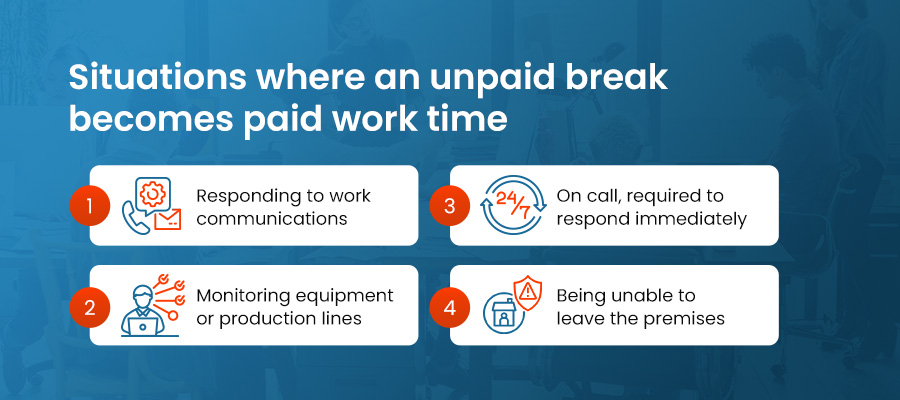
Situations where an unpaid break becomes paid work time include:
- Responding to work communications, such as answering phones or replying to emails.
- Monitoring equipment or remaining responsible for production lines.
- Staying on call and being required to respond immediately.
- Being unable to leave the premises.
According to federal guidelines, if an employee cannot use the time freely, it’s considered hours worked and must be compensated.
What Is the Process for Legally Shortening an Employee Meal Period?
Some employers may wish to provide a shorter employee meal period than state law requires. This is only permissible through a process established by the New York Department of Labor. Employers must obtain a permit authorizing the shorter meal break and post it at the workplace.
Without formal approval, providing a shorter employee meal period than required constitutes a violation. The permit process ensures deviations are documented and approved.
How Does the One Employee Shift Exception Work?
An exception exists when only one employee is working a shift. The lone employee may consent to take a paid on-duty meal break rather than an unpaid one. Because the employee cannot be completely relieved from duty when they’re the only person present, the law recognizes this limitation.
The employee may eat on the job while remaining available. This one-employee exception requires the employee’s consent.
Practical Steps for Employer Compliance in New York
Putting knowledge into practice to ensure ongoing employer compliance is what truly protects your business. Poster Compliance Center helps organizations stay current with evolving requirements through labor law poster solutions that automatically update when regulations change.
Understanding the Financial Risks of Noncompliance
Failing to comply with New York meal and rest break requirements can result in significant penalties. The financial risks of noncompliance include multiple forms of liability.
- Compensation: Employees who don’t receive mandatory meal periods must be paid for the time worked.
- Overtime pay: If hours exceed 40 in a week, employers must pay overtime.
- Wage reimbursement: Employers may have to reimburse workers for wages unlawfully withheld.
- Reinstatement or restoration: Employers must reinstate suspended or terminated workers or restore their seniority.
- Liquidated damages: Employers could be required to provide the employee 100% of all unpaid wages plus interest.
These penalties demonstrate why preventing violations is more cost-effective.
Following Federal Record Keeping Best Practices
Accurate record-keeping provides your best defense in demonstrating compliance. Federal law requires employers to maintain complete time records. These record-keeping requirements apply to all employers covered by the FLSA.
Your records should clearly show when employees begin and end shifts, when they take meal breaks and break durations. Maintaining detailed documentation helps you prove you’ve met obligations under both New York meal and rest break law and federal standards. This proactive approach to record-keeping minimizes risk.
Stay Compliant With Poster Compliance Center
Mastering New York’s meal and rest break rules is the first step, but ensuring ongoing compliance as regulations evolve is what truly protects your business. Poster Compliance Center helps organizations achieve peace of mind by handling the details so you can focus on running your business.
We provide fully compliant New York labor law posters that meet all mandatory federal, state and local requirements. For businesses with multiple locations or complex needs, our corporate compliance solutions offer centralized management with dedicated support. Those seeking long-term peace of mind can explore our subscription plans that include automatic updates whenever regulations change.
Request a quote today and let our compliance experts guide you to the right solution.