

Is your human resources department spending hours tracking labor law changes and updating workplace compliance posters? Handling these tasks in-house generates costs that most businesses underestimate, especially when managing multiple facilities in different cities and states. What seems like something simple can quietly drain your budget and expose your company to costly fines.
Managing these responsibilities on your own requires someone to research regulations, distribute materials and post signage. Every time the laws change, your staff needs to invest more time, which can distract them from their core responsibilities.
This guide provides the tools to calculate HR compliance ROI for your organization’s poster management process. We will show you how those numbers compare to the costs of automated service plans and how changing your poster compliance strategy can provide long-term cost savings to your company. If you’re building a business case for compliance software or need to know how to justify HR software costs to leadership, this worksheet will give you the data you need.
Contact Us with Compliance Training Questions
In this Article:
- Poster Compliance Cost-Benefit Analysis — Calculating Your In-House Costs
- Step 1: Annual HR and Administrative Labor Costs — Calculate Time Savings for Automation
- Determine Your Total Annual Labor Costs
- Step 2: Annual Material and Shipping Costs — Poster Subscription Value Proposition
- Determine Your Total Annual Material and Shipping Costs
- Step 3: Calculate Your Annual Risk Exposure Costs — Compliance Service Cost vs. Fine
- The ROI Calculation — Putting It All Together
- The Benefits Beyond the Numbers — Cost-Saving Compliance Automation
Poster Compliance Cost-Benefit Analysis — Calculating Your In-House Costs
Most companies undervalue their spending on poster compliance since the costs are spread out over multiple departments and often disguised as administrative work. Finance teams see individual line items for printing and shipping without connecting them to poster compliance. HR departments absorb many of these costs without tracking the time or knowing everything needed to comply with labor laws.
The real financial impact is visible when you add up all the expenses and consider what your team could have accomplished if not burdened with these tasks. Every hour your HR professionals spend researching regulatory changes and printing posters is time not spent on employee relations, talent acquisition, training or workplace activities.
Understanding these hidden costs involves breaking down all the time and money you’re currently investing. From researching and verifying new requirements to distributing and installing signage, every step uses resources that could benefit other areas of your business.
Let’s examine each cost category that shows the money you are losing. You can use the following formulas as your cost of HR noncompliance calculator to see the true impact.
Step 1: Annual HR and Administrative Labor Costs — Calculate Time Savings for Automation
Most of your money goes to time and labor, and it’s the cost that surprises people the most. Effective compliance monitoring requires knowledgeable people familiar with the regulations and how they apply to your business. You can’t assign these tasks to someone inexperienced — it takes a person who thoroughly understands HR and employment law.
Think about what your team has to track. The Department of Labor, Equal Employment Opportunity Commission (EEOC), Occupational Safety and Health Administration (OSHA) and other federal agencies have separate posting requirements. Then, you must follow state-level rules that vary from state to state. Plus, counties and cities have separate requirements as well.
Everything changes constantly, and someone has to stay on top of it all.
Research and Monitoring
Someone from your organization must check government websites for changes and compare the new requirements against what you currently have posted. These tasks are not something you can do once or twice a year — the laws change constantly, and missing an update means you can face the penalties for noncompliance.
The amount of work involved can vary based on how many states you operate in. If you have locations across multiple states, you need someone who knows each state’s requirements. States like California, Colorado and Connecticut change their rules frequently, so someone has to check almost weekly during legislative sessions. Even quiet states can sometimes surprise you with unexpected updates.
Calculate the variable: (Average hours per month) x 12 x (employee’s hourly rate) = A
Procurement and Verification
Once you notice a change, someone on your staff must locate the updated materials and verify their accuracy. The process could involve spending hours on government websites that aren’t easy to follow, downloading files on your computer and confirming that everything meets the requirements that pertain to your organization.
Precision is critical at this step. Posting the wrong information is just as risky as not having any signage at all. You must verify the poster is official, check the date it goes into effect and make sure the formatting meets posting standards. Handling this step requires someone with the proper knowledge, experience and attention to detail.
Calculate the variable: (Average hours per update) x (average number of updates per year) x (employee’s hourly rate) = B
Distribution and Communication
Distributing updated posters involves adding more time for each location in your organization. Someone must prepare the materials for each site, while considering that requirements might differ for each city and state. This step requires packaging the posters, arranging shipping and explaining the posting requirements to local managers.
Managing the process goes far beyond shipping the materials. Local managers need clear instructions about which posters to remove, where the new ones go and how to verify everything is posted correctly. Some posters need to go up immediately, while others have grace periods — all of which someone has to track and manage across your entire company.
Calculate the variable: (Average hours per labor law update) x (number of locations) x (employee’s hourly rate) = C
Determine Your Total Annual Labor Costs
To determine how much money you invest in labor each year, add all three variables above.
Total annual labor costs: A + B + C
Step 2: Annual Material and Shipping Costs — Poster Subscription Value Proposition
While materials and shipping costs are easy to follow in accounting, they are often larger than you think when you multiply them across all your locations and factor in how often you need new posters. Additionally, you need high-quality material that will last as long as needed, which is much more costly than printing posters on standard copy paper.
Materials
Professional poster printing requires heavy-duty paper and high-quality printing that can withstand wear and tear in break rooms, warehouses and manufacturing floors. Regular office printers and multipurpose paper won’t cut it — the text fades, pages tear and illegible posters result in noncompliance, even if they have the correct information.
Additionally, outdoor areas require weather-resistant materials. Some municipalities or states have specific requirements for text size or high visibility that only professional printing equipment can handle.
These material costs add up quickly across each location every time an update occurs, as a single change in the labor laws can mean dozens of new posters.
Calculate the variable: (Cost per poster) x (number of locations) x (average number of labor law updates per year) = D
Shipping
When you face hard deadlines that go into effect immediately, you can’t rely on standard shipping. Not posting an update in time can result in violations, so you need to pay for expedited shipping to distribute the posters on time. These shipping costs increase for every location in your organization.
Companies with multiple locations often have different shipping needs. Remote facilities might need special delivery or pickup arrangements. Some updates require overnight shipping to meet deadlines, which can get expensive quickly.
Plus, there’s hidden labor for packaging materials, labels, printing the posting instructions and tracking deliveries to make sure everything arrives on time.
Calculate the variable: (Cost per package) x (number of locations) x (average number of updates per year) = E
Determine Your Total Annual Material and Shipping Costs
Add both of the above variables to calculate how much money you spend on materials and shipping yearly.
Total annual material and shipping costs: D + E
Step 3: Calculate Your Annual Risk Exposure Costs — Compliance Service Cost vs. Fine
Noncompliance is a reality that you must include in your cost analysis. Even if you have never been fined, the possibility of a violation increases whenever you handle the tasks manually. As you add more locations and deal with more updates, the chances of making mistakes increase.

Understanding Violation Risk
Violations can happen in several ways. Most commonly, your team misses a regulatory update. Sometimes you catch the update but don’t implement it fast enough. Other times, local managers install posters incorrectly or in the wrong location. The problem is that these issues can go unnoticed for weeks or months until an inspector shows up.
Average Fine Structure
Penalties vary depending on the type of violation, how long it’s been happening and whether inspectors think you’re making an effort to stay compliant. First-time violations usually get smaller fines, but repeat violations or obvious noncompliance can trigger much higher penalties.
Single poster violations typically result in fines from hundreds to thousands of dollars. Multiple violations found during one inspection often get combined penalties higher than individual fines. Some states charge daily penalties for ongoing violations, meaning that costs continue to escalate until you fix the problem.
Likelihood Factor
You need to be realistic about how reliable your current process is. Look at your track record with updates and any inspection results you’ve had. You should also consider whether employees who previously handled these responsibilities are no longer with your company.
Multilocation businesses should think about risk on a per-location basis, as compliance failures usually happen at individual sites rather than company-wide. Remote locations with less oversight are typically higher risk. High-traffic locations undergo inspections more often, increasing the chances for violations and fines.
- Calculate the variable: Start with a realistic fine amount for your situation — let’s use $1,000 for a violation. Next, estimate the chance of that violation occurring at one of your locations for however many times a year. For example, if you think there’s a 20% chance of missing an update or having a posting error one time, your calculation would be a $1,000 (potential fine) × 20% (likelihood) = $200 annual risk cost.
- Total risk-adjusted cost: (Potential fine amount) x (likelihood factor %) = F
The ROI Calculation — Putting It All Together
Your return on investment shows the financial impact of continuing with your manual processes versus investing in professional compliance automation. The numbers typically show that automated services pay for themselves within the first year through direct cost savings — and that’s even before considering the additional benefits that compound over the long term.
Breaking Down Your Investment Analysis
Use the following formulas to calculate your total ROI for subscribing to a labor law poster service:
- Your total annual in-house costs: (Total annual labor costs) + (total material and shipping costs) + (total risk-adjusted costs)
- Annual cost of automated service: (The annual subscription fee you pay to your service provider)
- Your net annual savings (ROI): (Total annual in-house cost) – (annual subscription fee)
Your net annual savings are measurable, first-year returns on investment from eliminating manual compliance management. The savings typically increase in subsequent years as labor costs rise and regulatory complexity expands. Many organizations eventually realize that their actual manual costs exceed the initial estimates after completing this detailed analysis.
Professional compliance services like Poster Compliance Center have developed an entire business model around delivering measurable value that exceeds the cost of a subscription. Our state and federal compliance plans eliminate every element of your manual cost calculations through precise, systematic automation and professional oversight.
Instead of your team monitoring dozens of government websites and regulatory announcements, our compliance professionals will track the changes that apply to your organization. We identify relevant updates, verify requirements and prepare location-specific materials without any involvement from your staff. While automatic notifications keep you informed about changes that affect your business, we handle all the research and preparation work behind the scenes.
Our professional fulfillment systems handle the tasks that once consumed hours of your team’s valuable time. Updated posters arrive at each location with clear installation instructions and removal guidelines for outdated materials. There are no coordination meetings, shipping arrangements or follow-up calls to confirm installation.
The Benefits Beyond the Numbers — Cost-Saving Compliance Automation
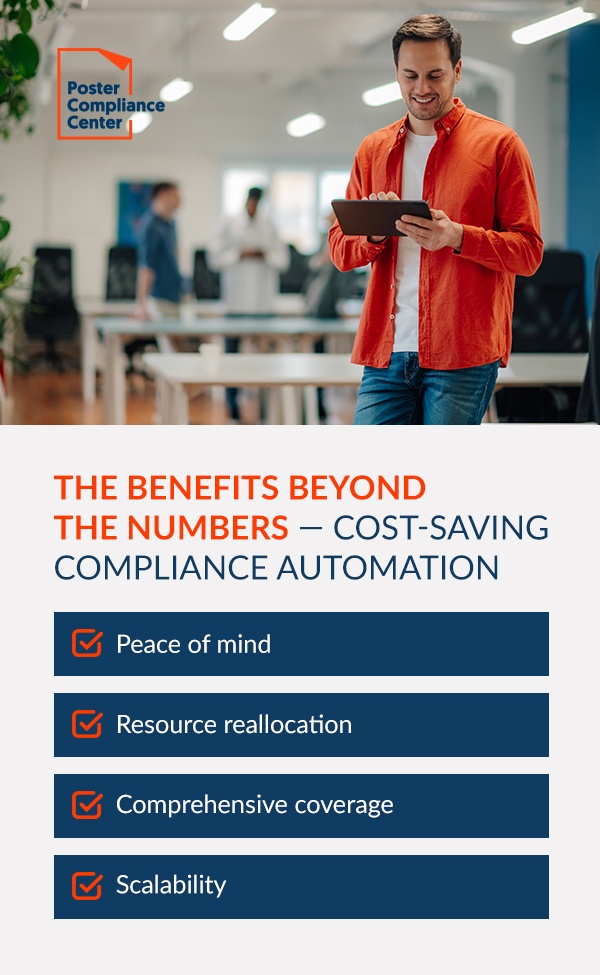
While the ROI calculations show quantifiable numbers, Poster Compliance Center delivers many other benefits that add value to your business. Examples include:
- Peace of mind: Our services include financial guarantees that significantly change your risk profile. As long as you use the materials we sent you properly, our warranty coverage means we’re responsible for any federal or state poster violations during your subscription plan.
- Resource reallocation: Eliminating in-house responsibilities frees your HR team to work on initiatives that can drive success for your business in other areas. Instead of researching poster requirements, your professionals can focus on strategies that reduce turnover costs and improve your company’s overall productivity.
- Comprehensive coverage: Traditional wall posters address only part of your compliance requirements in today’s workplace. Remote employees and hybrid workers often need access to labor law information that physical posters can’t provide. Solutions like eComply360 deliver complete coverage regardless of where your employees work.
- Scalability: When you handle your compliance responsibilities in-house, opening a new location involves more research, added coordination and the possibility of mistakes. Our services flip the equation — we handle all your needs, whether you have one location or a hundred.
Discover More With Poster Compliance Center
Your numbers from the above worksheet tell the whole story — handling your compliance responsibilities manually costs much more than most companies realize, and professional automation starts paying dividends almost immediately. Beyond the cost savings, you recapture time for your HR team to focus on their core responsibilities instead of chasing regulatory updates. Plus, you get guaranteed compliance protection that eliminates risk entirely.
Poster Compliance Center’s corporate compliance services handle all your organization’s needs, from monitoring regulatory changes to shipping updated materials to your locations. If you want to learn more about how these solutions can benefit your business, our experts can help. Call 800-322-3636 or contact us online today for a free quote or to request additional information.