
Many workplaces have adopted a hybrid or fully remote approach for their employees. While these flexible arrangements offer obvious advantages, they also create new compliance challenges. Labor laws still require companies to display workplace posters in a visible location, but businesses with employees spread across multiple states need digital tools to keep everyone informed of their rights.
Several states now mandate digital posters when applicable, shifting digital compliance solutions from a convenience to a necessity. These platforms protect your organization from costly penalties and reinforce the trust your employees place in you to keep them informed.
Though some companies manage compliance manually, those methods are increasingly challenging to sustain as regulations evolve and teams become more distributed. If you’re an HR leader or finance manager, this labor law compliance guide will help you understand why investing in a digital solution is practical and essential.
In This Article
- The Hidden Operational Burden of Manual Compliance
- Why the Logistics of Manual Compliance Are Unsustainable
- The Financial Risks of Manual Labor Law Compliance
- Why Digital Compliance Is a Strategic Solution
- Frequently Asked Questions
The Hidden Operational Burden of Manual Compliance
Your HR team’s internal management and strategic functioning determine its success. Manual compliance tasks place an unnecessary burden on your team’s daily activities by increasing their workload. In 2024, 62% of HR professionals expressed that their teams operate beyond typical capacity. Busywork and burnout will ultimately detract from departmental effectiveness.
HR teams often wear multiple hats, tackling administrative tasks, brainstorming growth strategies and resolving employee disputes. Adding manual compliance shifts focus away from mission-critical initiatives. It’s also harder to guarantee 100% compliance, given the department’s divided attention.
Why the Logistics of Manual Compliance Are Unsustainable
Time is money for every organization, and every hour someone spends on administrative tasks pulls their attention away from high‑impact work. When HR leaders get caught up in the minutiae of labor law changes, they can’t focus on improving culture, strategy or employee experience — all of which directly influence your company’s competitiveness.
Because labor laws shift frequently, staying compliant requires constant monitoring. Without a reliable system, your organization can easily end up with outdated posters, incorrect specifications, missed deadlines or missing notices. Manual compliance increases the likelihood of these errors, and it only takes one to trigger a violation. The risk grows even faster as your company expands, especially if you operate across multiple states or locations.
Labor laws can change hundreds of times a year, and keeping up with those updates can be a full-time responsibility. Tracking federal, state, county and industry‑specific requirements becomes even more complex if you operate in multiple locations. For instance, a company with employees in three different states must monitor each state’s rules and local posting requirements.
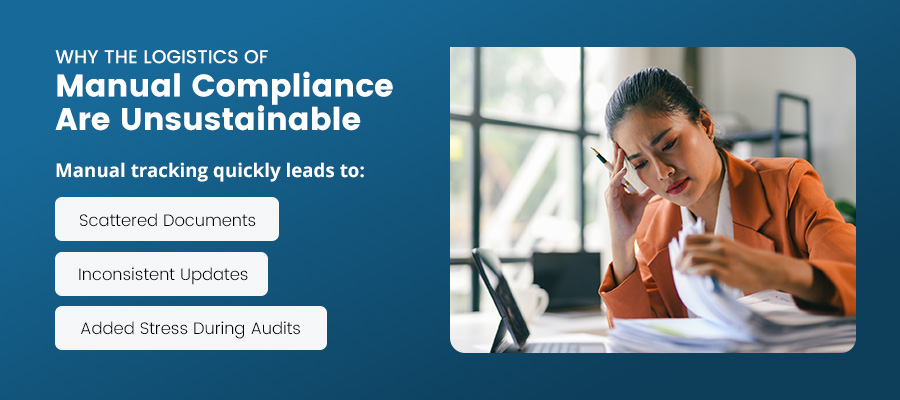
For organizations with a distributed workforce, manual tracking quickly leads to scattered documents, inconsistent updates and added stress during audits. Printing and shipping physical posters adds another layer of cost and logistics, especially when employees work from home. These challenges are avoidable. Compliance partners and digital solutions streamline the entire process, reducing administrative burden and ensuring your team always has the most current information.
The Financial Risks of Manual Labor Law Compliance
Manual processes make budgeting for multistate labor law compliance unpredictable. Errors can lead to hefty fines and lawsuits. In making the financial case for digital compliance, consider the compounding effects of such risks.
The Federal Civil Penalties Inflation Adjustment Act
The Inflation Adjustment Act is a federal law that requires the Department of Labor to adjust civil penalties annually to account for inflation. This adjustment includes penalties for noncompliance with labor law poster requirements. For instance, violations against the Occupational Safety and Health Administration’s required posters increased from $16,131 to $16,550 in 2025.
Organizations that fail to comply with poster requirements often commit other violations. OSHA can charge you the following fines.
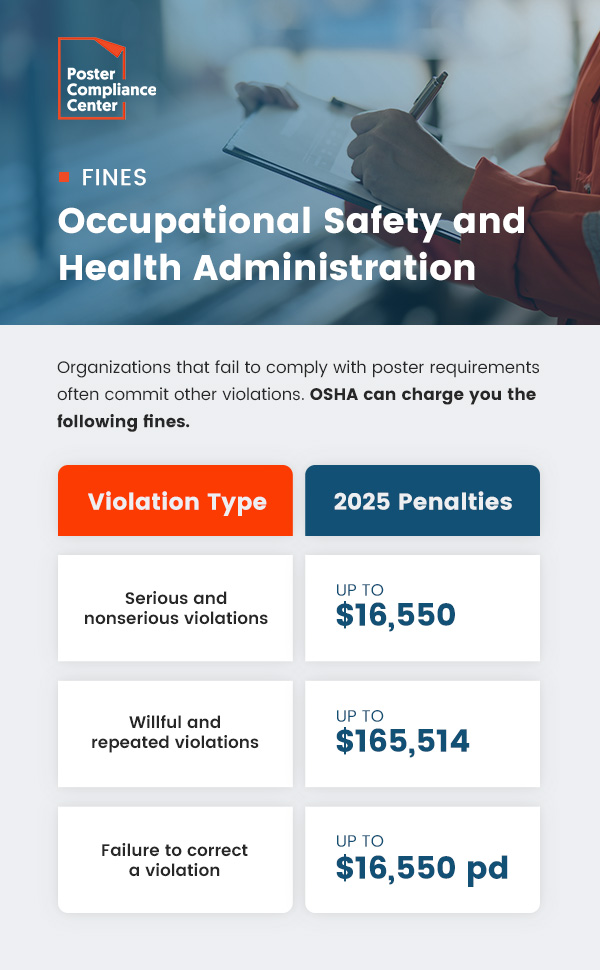
| Violation Type | 2025 Penalties |
|---|---|
| Serious and nonserious violations | Up to $16,550 |
| Willful and repeated violations | Up to $165,514 |
| Failure to correct a violation | Up to $16,550 per day |
Annual adjustments typically occur at the beginning of the year, based on the Consumer Price Index for All Urban Consumers. The Office of Management and Budget provides the annual multiplier, rounded to five decimal points.
Hybrid and Remote Work Multiply Risks
Remote and field workers must receive the correct posters for their specific locations, and those requirements escalate quickly when states and counties have different rules. These workers also need continuous access to the notices, which is far harder to guarantee outside a traditional office. Emailing posters is an option, but it often leads to disorganized records, which can become an issue when you need proof of receipt to settle legal disputes.
The Legal Repercussions
You must look beyond administrative costs when budgeting for compliance or doing a cost analysis of manual vs. automated compliance. For example, penalties can add up quickly. Violations tied to the Americans with Disabilities Act, Title VII, the Pregnant Workers Fairness Act or the Genetic Information Nondiscrimination Act can reach up to $698 per offense, while Family and Medical Leave Act violations can cost up to $216 each.
Every labor law poster has separate requirements, and even minor oversights can trigger fines. For example, you must print the FMLA notice in a readable size and display it in a prominent location, even if none of your employees currently qualify for FMLA leave.
These issues rarely occur in isolation. Poster violations tend to overlap with other workplace findings, increasing your legal exposure. For instance, if an employee raises a minimum wage concern, agencies like the DOL or EEOC may also cite outdated minimum wage posters as evidence of broader noncompliance. Beyond legal fees, losing a case can result in additional damages — making manual compliance a costly risk.
How Risks Impact Employee Trust
Once you’ve spent the time, energy and resources needed to attract top talent, you should protect your investment by retaining your staff. People expect their employers to behave with fairness and integrity, so demonstrating your respect for their rights by complying with labor law posting requirements reinforces trust.
Leadership practices are another factor that shapes the employee experience. When HR teams become overwhelmed with manual compliance tasks, they’ll support employees less effectively. In 2024, one‑third of workers reported dissatisfaction with ineffective senior leadership, yet employees view HR more positively when the department uses modern tools that streamline administrative work. Organizations that adopt HR tech see turnover decrease by an average of 1.2%.
Compliance also matters in legal contexts. If your organization mismanages poster requirements, it becomes harder to argue that you acted in good faith. That gap in documentation can influence how the court decides to assess damages in a lawsuit.
Why Digital Compliance Is a Strategic Solution
When calculating the ROI of digital labor law posters, consider how they affect your organization. For instance, HR maturity, which pertains to how effective and advanced your HR department is, influences your company’s financial performance. Fifty-one percent of HR teams with high maturity exceeded their fiscal objectives in 2025. One company with more than 1,000 employees and a high HR maturity also generated $62,000 more revenue per employee than another company of the same size.
Digital compliance solutions create a competitive advantage, since only one in eight HR functions reaches high maturity. Meanwhile, about 30% of low-maturity organizations experience high turnover rates.
Small startups and established enterprises can get accurate, updated posters for their remote and hybrid workforces through Poster Compliance Center’s corporate compliance program and eComply360 platform.
What eComply360 Can Do
eComply360 is a digital platform that automatically supplies your remote and hybrid teams with the latest labor law posters. Employees can access and download the posters specific to their locations, saving your in-house team the time and energy they would otherwise spend on monitoring changing regulations.
Your employees will also get free updates throughout your subscription. We’ll notify them of mandatory changes through the dashboard or email. Having a centralized platform simplifies user access. Your employees can log in anytime, or skip logins via a custom link to your internal intranet.
Pairing the digital platform with our corporate compliance solution creates a complete package for your workplace. Our corporate solution offers updated, accurate physical posters wherever your business operates. We’ll handle the monitoring and shipping logistics. Leaving the work to us streamlines the compliance process for your HR team.
The Level of Research a Compliance Partner Brings
Automated labor law updates ensure compliance for your HR leaders. Our dedicated research team monitors 50 states and thousands of municipalities daily, so you can focus on business initiatives that drive growth. When mandatory changes occur, we update our platforms automatically and notify your team.
The $41,000 Fine-Free Guarantee
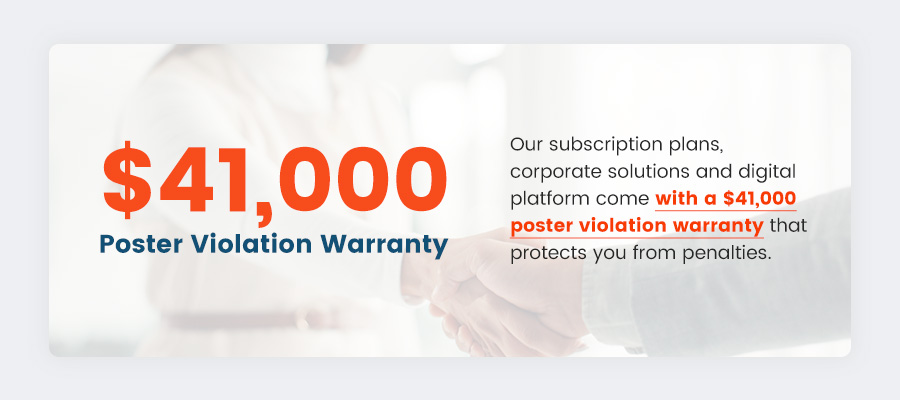
While manual compliance comes with risks, Poster Compliance Center offers a guarantee. Our subscription plans, corporate solutions and digital platform come with a $41,000 poster violation warranty that protects you from penalties. We transfer the financial liability from your company to ours, offering budget certainty. You can be sure that the posters are legally accurate and contain every notice the federal, state and local governments require.
Frequently Asked Questions
This Q-and-A will help you further appreciate the impact of digital compliance.
What Does Digital Compliance Mean?
Digital compliance refers to meeting the growing number of laws requiring employers to provide electronic versions of mandatory workplace posters to accommodate remote workers. While the law still instructs employers to display traditional physical notices in a conspicuous location, remote and field employees don’t have access to those spaces — making digital delivery an essential alternative.
Several states have already adopted these rules. In New York, agricultural employers must provide digital copies of required postings through a website or email. Illinois requires employers with remote workers to supply electronic posters directly to those employees. As more states update their regulations, digital compliance is becoming a critical part of meeting labor law obligations.
What Are the 4 Pillars of Compliance?
The four pillars of compliance include appointing a compliance officer, performing risk assessments, using a monitoring and auditing system and setting up internal policies. Reviewing these can help you determine the effectiveness of your compliance strategy.
- Compliance officer: Do you have an HR leader who oversees the company’s compliance strategies? This person should have expertise regarding industry and regulatory requirements. A partner like Poster Compliance Center can help.
- Risk assessment: Which factors influence risk for your company? Consider your industry and work setups. After you identify such risks, assess their impact.
- Monitoring and auditing system: You won’t need extra tools to stay abreast of evolving labor laws. Poster Compliance Center’s dedicated research team will review the changes for you, which you’ll benefit from through an eComply360 subscription or using our corporate solutions.
- Internal policies: Internal policies impact workforce management, which affects your compliance level. Consider your written policies and procedures to enforce them. For instance, how do you require your remote employees to review the workplace posters? How do you track acknowledgments?
What Is the Most Effective Compliance Strategy?
The most effective compliance strategy for poster requirements is finding a reliable partner. For instance, Poster Compliance Center delivers mandatory workplace posters to the appropriate locations. Our notification systems also ensure your team stays up to date on the latest labor law changes.
Poster Compliance Center Simplifies Digital Compliance
Digital solutions go beyond cost savings, providing compliance peace of mind for your HR leaders while helping them focus on growth-related tasks. With Poster Compliance Center, you can take advantage of our $41,000 warranty to protect you from increasingly costly civil penalties.
We produce about 3,000 posters per day and ship an average of 12,000 posters monthly to locations throughout the country. We have had no violations of poster requirements in over 32 years in business. If you’re looking to automate poster compliance, we can help.
Explore our corporate solutions today if you’re an established business serving multiple locations. Our eComply360 platform covers your remote and hybrid workforce. You can also consider our annual plans for mandatory federal and state workplace posters. Request a custom quote today to get started.