

While hybrid work has its benefits, it opens teams up to new compliance challenges. Over the past few years, the shift to hybrid work has rendered the traditional “break room wall” model for labor law posters somewhat ineffective. Proactive HR teams often update physical mandatory posters in the office, but fail to account for remote employees’ legal right to the same information.
With employees living and working in different locations from your company HQ, you can find yourself a victim of the “locality trap.” Although your in-office posters might tick every box of your HQ location’s regulations, your HR team could forget to customize city and county labor law posters for remote workers.
This scorecard provides an easy way to diagnose gaps in your poster compliance and immediately identify liability. Discover how to eliminate the risks of noncompliance with this accessible 10-point HR risk audit for labor law posters.
Shop Our Digital Compliance Solutions
In This Article
- Section 1: Jurisdiction and Law Coverage
- Section 2: Proof and Delivery for Hybrid Workers
- Section III: Maintenance and Audit Preparedness
- Achieving a Perfect 10: Automating Your Scorecard
Section 1: Jurisdiction and Law Coverage
Compliance posters must cover a complex web of federal, state and local regulations over a wide range of legal areas.
Explore the four key points to include to ensure compliance with jurisdictional and legal requirements:
1. Federal and State Base Coverage
Any employer with one or more employees must display certain posters at their place of business to ensure employees have access to important information about their rights.
Alongside nationwide federal requirements, state laws often require additional state-specific posters, such as those on minimum wage, safety regulations and workers’ compensation.
Core federal law posters required by the U.S. Department of Labor (DOL) include:
- Fair Labor Standards Act (FLSA): The FLSA covers minimum wage, record keeping, overtime and youth employment standards.
- Occupational Safety and Health Act (OSH Act): The primary U.S. law governing workplace safety covers compliance and training requirements for employers in all 50 states and other U.S. jurisdictions.
- Equal Employment Opportunity (EEO) Laws: Enforced by the Equal Employment Opportunity Commission (EEOC), EEO laws prohibit discrimination in the workplace and promote the implementation of federal civil rights laws.
- Family and Medical Leave Act (FMLA): All employers with 50 or more employees are required to outline qualifying workers’ rights to unpaid, job-protected leave.
- Employee Polygraph Protection Act (EPPA): The EPPA covers the types of employers that are forbidden from using lie detector tests on employees.
- Uniformed Services Employment and Reemployment Rights Act (USERRA): This federal law protects veterans and members of the military service from employment discrimination.
For every employee location, your posters must include information on all federal and state requirements, laws and updates.
2. The Locality Trap
There is a high risk of noncompliance for employers operating in multiple states or municipalities, or with remote employees in different locations. With the rise of city and county mandates that apply to remote workers, it is increasingly important to ensure all employees are equipped with the necessary information pertaining to their specific locations.
For example, employers may accidentally use a general, national or state-specific poster in a location that requires city-specific information to be compliant. Even when their primary location’s posters are compliant, some employers fail to provide tailored information for their remote employees based in locations with differing mandates.
To ensure compliance, include all location-oriented mandates for every remote employee location.
3. Poster Language Requirements

In the U.S., employers must provide certain mandatory workplace posters both in English and in any other languages spoken by their employees.
According to the DOL, employers, contractors and subcontractors must provide the following mandatory notices in the languages spoken by their employees:
- FMLA poster
- Notification of Employee Rights Under Federal Labor Laws poster
- Migrant and Seasonal Agricultural Worker Protection Act (MSPA) poster
- Immigration and Nationality Act poster
4. Industry-Specific and Specialized Posters
Alongside the mandatory federal and state labor law posters, certain companies are required to supply additional posters specific to their industry or unique employee needs.
- Agricultural businesses must provide the MSPA notice.
- Government and public sector organizations have specific poster requirements. For example, federal contractors and subcontractors must display additional notices, including the Employee Rights Under the National Labor Relations Act.
- Employers with certificates for hiring workers with disabilities must display a poster on Employee Rights for Workers with Disabilities.
Determine whether your company is required to provide additional posters, and ensure all relevant employees are equipped with the necessary industry-specific and specialized information.
Section 2: Proof and Delivery for Hybrid Workers
Even employers who provide the mandatory information can fail to be fully compliant if they do not do so correctly. Without proof of delivery, proof of acknowledgment and consistent poster validity, you risk failing compliance standards and facing fines, legal penalties and lawsuits.
5. Proof of Delivery
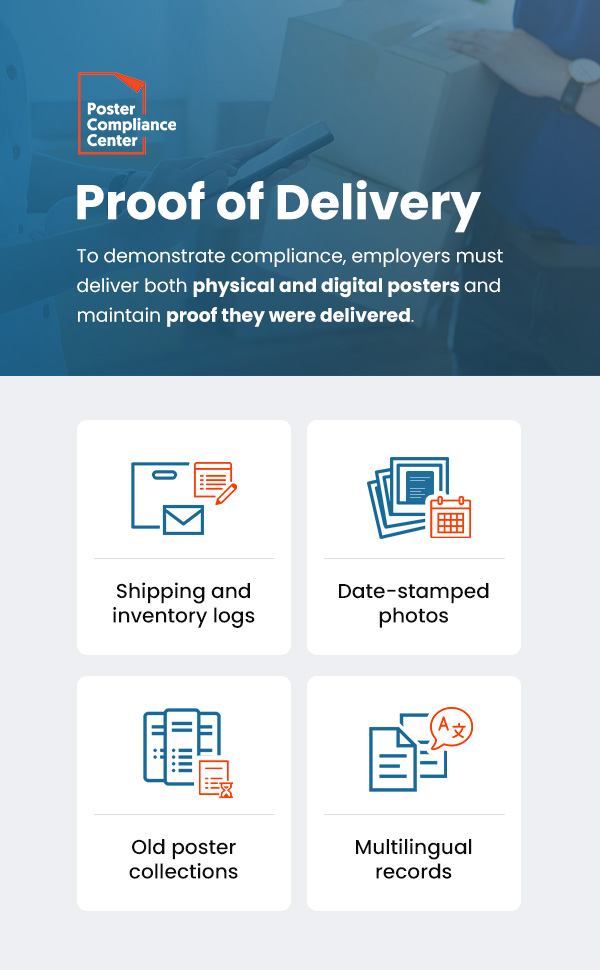
To demonstrate compliance in a hybrid work environment, employers must deliver both physical and digital posters and maintain proof that they were accessible to employees.
Under most U.S. compliance regulations, it is not enough to simply have the correct posters — you must maintain records demonstrating that each remote employee has received and had access to the required electronic notices. This aspect is crucial for compliance.
Although not mandatory, other recommended best practices include:
- Shipping and inventory logs: Maintaining an inventory log of all poster orders, tracking numbers, edits and deliveries can help prove the delivery and receipt of posters in each location.
- Date-stamped photos: Once posters have been received and set up, consider requesting photos of them to prove they have been accessible to in-office employees for the required durations.
- Old poster collections: When you update posters to comply with new regulations and mandates, keep the older posters for up to three years, in case you need to prove their existence in the future.
- Multilingual records: Try to retain proof of delivery for all different versions of your posters, especially for those you are obliged to provide in different languages.
Without verifiable proof of accessibility, it becomes your word against the employee’s, or the government’s assumption that you were not compliant. Think of proof of delivery as your primary defense that you made a good-faith effort to disseminate the required information.
6. Proof of Acknowledgment
Proving the delivery of digital posters is hard without proof of acknowledgement. Unlike physical posters, which you can prove delivery of with physical evidence, you cannot prove receipt of a digital copy without confirmation from the remote worker.
Use an electronic system to request acknowledgment from employees anytime they receive a new poster or a poster changes. It is important to make sure your employees know the necessity of acknowledgment so they are more likely to participate. Consider covering proof of acknowledgment during employee onboarding, especially for remote and hybrid workers, who access posters outside the office.
Here are a few points to review during onboarding:
-
Purpose explanation: During an orientation session, briefly explain the importance of labor law posters. Emphasize that they outline the employee’s legal rights and protections and are crucial resources for their well-being and understanding of company policies.
-
Digital access instructions: Provide clear, step-by-step instructions on how the new remote employee can access their customized digital labor law posters. This access should typically be through a secure company intranet, HR portal or a dedicated compliance management platform. Ensure the platform is easily navigable and accessible from their company-provided device (if applicable).
-
Formal acknowledgment: Integrate a mechanism for the new remote employee to formally acknowledge receipt and review of digital posters. For example, some platforms, like eComply360, prompt employees to acknowledge receipt of every document and store each acknowledgment in the portal’s dashboard. This way, HR teams can see acceptance rates and manage compliance at scale.
7. Poster Validity
To ensure all posters you are providing are valid, you must keep track of mid-year mandatory updates, such as minimum wage increases and EEO law changes.
- Checking public sites: Regularly check city and state labor department websites for mandatory updates and regulation changes.
- Automating poster updates and deliveries: Choose a partner, like Poster Compliance Center, that automatically updates and delivers posters in line with changing regulations.
- Conducting mid-year reviews: Conduct internal compliance reviews throughout the year to help you diagnose compliance gaps and strengthen your compliance procedures.
Section III: Maintenance and Audit Preparedness
Maintain compliance throughout your organization by ensuring your organization follows a few specific processes.
8. Document Retention Policy
Although the DOL has no official overarching guideline for document retention, some specific regulations or programs do have explicit record retention requirements. For example, employers in the H-2A temporary agricultural employment sector must maintain all relevant documents and records for three years. It is always advisable to keep records of your physical and electronic posters for at least three years to help prove past compliance. Clearly marking old documents as “outdated” can also prevent accidental reuse and additional compliance issues.
9. Centralized Compliance Platform
Keeping track of poster deliveries, edits, updates and acknowledgments can be challenging across a hybrid workforce. When you invest in a comprehensive, centralized platform, you can manage all aspects of your digital poster compliance from one place.
Our Virtual Compliance Portal (VCP) and embedded eComply360 notice service offer several features to improve your process, including:
- 24/7 digital access to documents for all employees
- Free automatic updates in line with new mandates and law changes
- Location-specific and multi-jurisdictional labor law compliance
- Poster update notifications
- Compliance warranty
- Comprehensive document storage
10. Audit Simulation Ready
One of the best ways to ensure audit preparedness is to run internal audits of your labor law poster compliance.
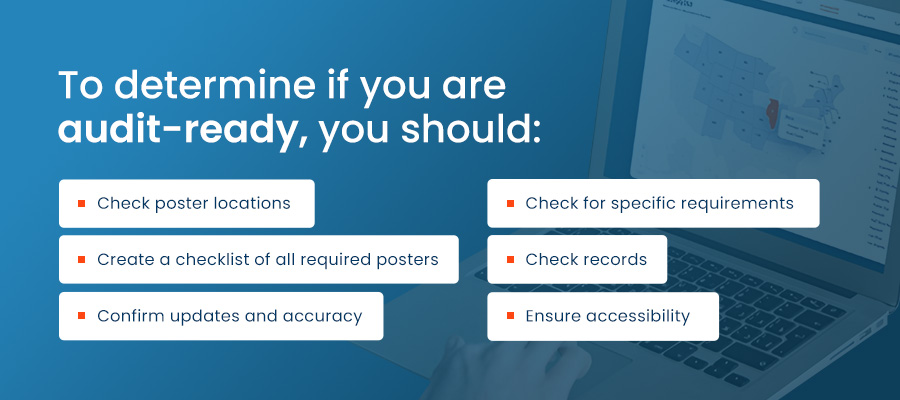
To determine if you are audit-ready, you should:
- Check poster locations: Place your physical mandatory compliance posters in communal, conspicuous spaces, such as break rooms.
- Create a checklist of all required posters: Ensure every poster required for your organization is present, both in-office and digitally, using a separate compliance checklist for your hybrid and remote employees.
- Confirm updates and accuracy: Analyze the veracity and validity of information on each poster so it aligns with the most recent legislative updates.
- Check for specific requirements: Some posters have specific font and sizing requirements. For example, some OSHA posters must be 8.5 x 14 inches.
- Check records: Create a clear evidence trail for the delivery and acknowledgment of all posters, including timestamped evidence of employees interacting with newly updated posters.
- Ensure accessibility: Any posters available digitally and via the intranet must be accessible 24/7. According to the eCFR, in the case of any intranet accessibility issues, employers must have evidence that they tried to resolve them as soon as possible, and that they could not have prevented the issues from occurring.
Achieving a Perfect 10: Automating Your Scorecard
Although having a clear scorecard can help you maintain compliance, it leaves room for human error. When noncompliance can result in fines, legal penalties and lawsuits, you need a solution you can count on.
Enter automated compliance with Poster Compliance Center’s eComply360 and Corporate Compliance plan.
eComply360 is our digital platform that streamlines compliance for hybrid and remote workforces across state lines, ensuring every employee has access to the latest, most accurate labor law posters for their location. With our automated compliance management system, you can stay ahead of changing regulations, thanks to its proactive communication, robust accessibility tools and comprehensive compliance updates.
Experience helpful automated digital compliance solution features:
- Free, automatic labor law updates
- Timely dashboard and email notifications for all mandatory updates
- Coverage for all states, cities and counties and their labor laws
- Secure document management and storage
- ADA-friendly design
- Downloading and printing options
- Acknowledgement tracking
- 24/7 access
- $41,000 poster compliance warranty
While eComply360 handles all your digital compliance needs, our Corporate Compliance solution automates your physical poster compliance. With free replacement posters automatically shipped in line with mandatory updates, our automated system ensures you are always compliant and protected.
When you combine our digital and physical automation solutions, our labor law experts can handle all poster requirements for you.
Formalize Your Compliance Risk With Poster Compliance Center
If you completed our scorecard and scored less than 10 out of 10, your company is carrying unnecessary compliance risk.
At Poster Compliance Center, we offer a personalized service and a guarantee of compliance. Through continual monitoring, free replacement posters, dedicated support and a comprehensive warranty, our clients are better protected from potential fines and legal challenges.
With our combination of automated corporate compliance solutions, you can eliminate guesswork and implement a system that guarantees coverage for all employees in all locations. Let your HR team focus on other essential tasks and leave all your poster regulation management to our team of labor law experts.
If you want to benefit from guaranteed coverage, contact us to request a formal compliance risk assessment or a demo of eComply360.