

Retailers experience unique compliance challenges, especially when they have teams spread across multiple locations. They often deal with high turnover rates, complex scheduling demands and shifting regulatory standards. State labor laws complicate things even further.
Merely covering the basics of the Fair Labor Standards Act at each location isn’t enough to sustain labor law compliance for retail chains. Employees may lack the resources they need to stay abreast of legislative changes, leading to potentially costly violations.
A centralized, systematic approach can prevent these issues and ensure multilocation retail compliance by simplifying, standardizing and scaling labor law compliance across your many locations. Keep reading to learn more about how outsourcing compliance can help your company overcome daily obstacles.
In This Article
- The Unique Compliance Fragmentation of Retail Chains
- High-Risk Retail Wage and Hour Compliance Pitfalls
- Specialized Retail Law Compliance Hot Spots
- Scaling Posting Compliance with Digital Solutions
The Unique Compliance Fragmentation of Retail Chains
Retailers often have dozens of locations spread across multiple cities, counties and states — all of which are subject to retail labor law posting requirements. Regulations governing factors like wages and breaks can differ dramatically in volume and detail.
Lack of a central digital compliance platform will force each retail location to research, develop and enforce a separate understanding of labor law compliance. This approach makes each location incredibly vulnerable to audits and class-action lawsuits. Your company can face serious legal, financial and reputational repercussions if a pattern of noncompliance emerges.
Poster Compliance Center’s digital compliance services unite your company’s approach to multilocation retail labor law posting requirements. We’ll create a single source of truth for all branches, then equip each retail location with the necessary information to keep your employees abreast of the area’s labor laws.
Our teams provide store-level poster compliance tracking and send free updated postings when labor standards change. We also curate a centralized HR compliance checklist for retail chains in our digital compliance platform, significantly simplifying your HR staff’s work. These systems keep your retail locations up to date with new labor laws and minimize the risk of compliance violations across the entire retail chain. The ROI of centralized retail posters is high as a result.
High-Risk Retail Wage and Hour Compliance Pitfalls
In 2025, retailers across the U.S. alone committed over 1,000 labor law compliance violations. While the specifics of each violation vary, three of the highest-risk areas for compliance violations are as follows.
1. Predictive Scheduling
Predictive scheduling law compliance in multistate retail is gaining nationwide momentum. The laws vary widely, though, and only Oregon has adopted predictive scheduling legislation at the state level. Highly populated metro areas, such as Los Angeles and New York City, have also adopted these laws, and many other jurisdictions are sure to follow.
These rapid legislative changes present an operational hurdle to retailers with multistate locations. West Coast HR teams are especially vulnerable. They may have two locations that must strictly follow the two-week rule and five that don’t. This inconsistency can lead to miscommunications and misunderstandings, and in the worst-case scenario, a retail location may even violate its entire staff’s labor rights. Audits, lawsuits and unnecessary turnover are the unfortunate results.
2. Breaks/Meal Periods
The rules preserving employee breaks and meal periods deserve consistent attention. Staffers may quit or pursue legal action if their employers ignore or mishandle those standards.
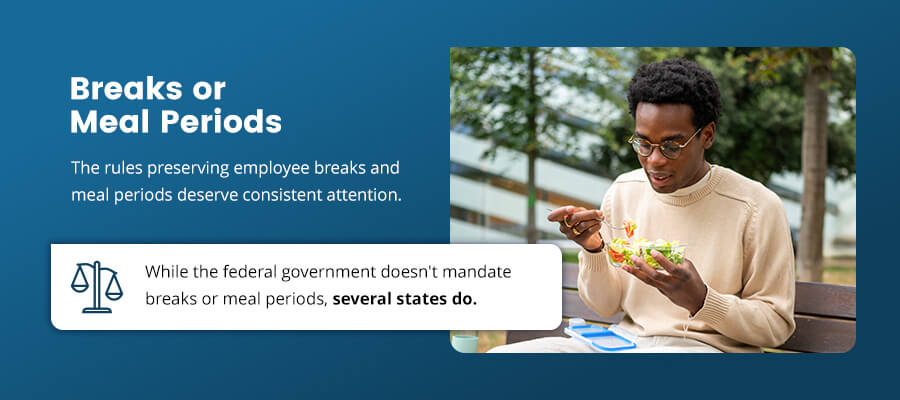
While the federal government doesn’t mandate breaks or meal periods, several states do. However, these are also in flux, with many jurisdictions considering laws against “clopening,” or back-to-back shifts that don’t give employees time to rest. Retailers may also have more specific standards that can create additional compliance violations.
Managing these standards is especially challenging during periods of seasonal hiring. New employees always need to receive up-to-date information on the relevant standards, no matter how long they intend to work at the company.
3. Overtime/Minimum Wage
The Fair Labor Standards Act established minimum wage and overtime pay in 1938, which have continued evolving since then. Many states, such as Arizona, Colorado and Michigan, have even passed laws that set a higher minimum wage than the FLSA.
Shifting payment standards create real challenges for retailers, and violations happen far too often. In 2025, labor violations resulted in over $8 million in back wages. Audits and lawsuits can compound the damage, especially when investigators find that employers knowingly ignored wage rules.
In the final retail compliance cost analysis, violations in this area are among the most dangerous of all.
Specialized Retail Law Compliance Hot Spots
Child labor and pay transparency have become focal points for lawmakers in recent years. Violations can lead to litigation and significant reputation damage. Two child labor infractions have led to over $200K in fines.
Child labor laws cover what jobs minors can legally able to do and how long they can work daily. Federal labor provisions state that children under 14 can only do a handful of nonagricultural jobs, such as babysitting and delivering papers. The FLSA also established work-hour limits for minors, though many states have stricter requirements in this area.
Pay transparency laws generally require employers to disclose pay ranges in job postings and contracts. They may also allow employees or the public to request information about companywide pay and benefits. These standards can be especially challenging for retailers to adhere to because only a handful of states have adopted them, such as Washington, Colorado and Minnesota. For multistate retailers, that means their recruiting, contracts and internal policies may have to shift completely in just one location.
Meeting these dual retail compliance challenges is complex when each retail location must follow different standards. Poster Compliance Center can help. We make pay transparency regulations and state-specific retail child labor law compliance simpler by tracking the relevant standards in real time and sending your locations brand-new posters when the regulations change.
Scaling Posting Compliance with Digital Solutions
As retailers grow, posting compliance becomes more challenging. You might expand into states with completely different labor laws or hire remote employees, who don’t have access to in-person postings. Each physical store needs its own postings, but this doesn’t help with managing retail labor law posters for remote HQ teams. Individual stores can also get lost in a sea of shifting regulations, putting the rest of the company at risk.
Poster Compliance Center’s digital compliance platform addresses all of these issues. It creates a region-specific standard that all remote employees and HR staff have access to. Our compliance teams also send out updates and notifications when labor standards change, allowing your company to keep pace with the world around it. The platform even uses e-delivery to create retail remote compliance documentation, simplifying the audit process.
Moving to a digital compliance model radically increases your company’s retail labor law poster ROI. Scaling becomes far more efficient, as does updating compliance postings in both retail locations and remote dashboards. Violations also become less prominent, decreasing your company’s unnecessary expenses.
Partner With Poster Compliance Center for Retail Compliance Today
Compliance issues are widespread, and solving them takes a comprehensive approach to avoid exposing your business to costly fines, lawsuits and ongoing risk. Poster Compliance Center’s robust solutions scale with your organization and keep pace with every change in labor law. We monitor new legislation and update your required postings so every retail location stays compliant and protected.
Our free Poster Code Checker provides a list of the required postings for each location, and our digital compliance platform, eComply360, empowers HR teams and remote workers to keep up with the latest shifts. Let us handle your compliance needs so you concentrate on growing your business.
Request a custom quote today or call 888-326-9036 to learn more.