

HR directors and labor law compliance professionals face a dynamic regulatory landscape that demands vigilance. When significant legislative proposals, like the Senate Labor Reform Package, emerge, adapting to complex federal changes can become challenging. This is especially true when assessing the potential impacts across multiple business locations and jurisdictions.
At Poster Compliance Center, our expert team conducts meticulous research and monitoring to stay up to date on all federal, state and local labor laws to ensure that organizations have the correct posters and remain compliant without exception. Rather than scrambling to interpret new requirements and assess impacts across multiple states, corporate HR teams can rely on proactive guidance and seamless compliance adaptation that automatically adjusts to regulatory shifts.
Staying on top of federal labor law updates in 2026 is easier with the right partner. Here is what employers should know about the labor reform package.
In This Article
- Understanding the Senate Labor Reform Package
- What to Know About the Worker RESULTS Act
- What to Know About the NLRB Stability Act
- What to Know About the Fairness in Filing Act
- Preparing Your Organization for Potential Changes
Understanding the Senate Labor Reform Package
The Labor Reform Package introduces comprehensive reforms aimed at overhauling U.S. labor laws, redefining the union election landscape and updating National Labor Relations Board processes. This package consists of seven bills, with three key pieces of legislation having the most significant impact on workplace compliance:
- Worker RESULTS Act
- National Labor Relations Board (NLRB) Stability Act
- Fairness in Filing Act
What Is the 2025 Senate Labor Reform Package?
On Nov. 10, 2025, the Chair of the Senate Health, Education, Labor and Pensions (HELP Committee), Senator Bill Cassidy (R-LA), introduced an ambitious legislative package designed to modernize federal labor laws. The comprehensive reform effort represents the most significant proposed changes to U.S. labor relations in decades.
The package consists of seven bills from multiple Republican senators, positioned as part of President Trump’s “Pro-Worker Agenda.” Key sponsors include Sen. Jim Banks (R-Ind.), Sen. Tommy Tuberville (R-Ala.) and Sen. Tim Scott (R-S.C.), each contributing specialized legislation addressing different aspects of labor relations.
Under current political dynamics with GOP control, the package faces better odds of passage than similar proposals in previous years. However, competing legislative priorities and potential defectors within the Republican caucus create uncertainty around timing and implementation. If passed, most provisions would likely take effect within 12 to 18 months, giving employers time to adjust their compliance procedures.
The legislative timeline depends heavily on Senate priorities, with confirmation of Trump Administration nominees and government funding bills taking precedence. HR professionals should monitor developments closely, as passage could happen more quickly than traditional legislative schedules suggest.
Why This Matters for Multilocation Companies
Federal labor law changes create uniform requirements across all jurisdictions, potentially simplifying compliance burdens compared to current state-by-state variations. For HR directors managing dozens or hundreds of locations, standardized federal requirements could reduce the complexity of maintaining different procedures across multiple states and circuits.
The proposed changes carry significant strategic planning implications for HR departments. Budget allocation for legal consultation, policy updates and training programs may need adjustment. Resource planning becomes particularly critical for companies with locations spanning multiple federal circuit jurisdictions, where different precedent applications could create varying compliance requirements.
Multilocation companies should also consider the implementation timeline. Unlike state-level changes that can take effect immediately, federal legislation typically includes transition periods. This provides HR teams with opportunities to develop comprehensive compliance strategies and update internal procedures systematically rather than reactively.
What to Know About the Worker RESULTS Act
While the Worker RESULTS Act has been proposed but not yet passed by the Senate, there is essential information to know about the bill that could impact your teams. The legislation represents the most comprehensive component of the reform package, fundamentally altering how union representation elections operate across all industries and locations.
Secret Ballot Requirements and Participation Thresholds
The proposed Worker RESULTS Act introduces several key changes:
- Eliminates “card check” unionization processes, requiring all union representation decisions to occur through NLRB-conducted secret ballot elections. This change standardizes the election process nationwide.
- Raises participation thresholds significantly, requiring at least two-thirds of bargaining unit employees to participate in representation elections, compared to the current simple majority requirement. This change could substantially reduce successful unionization efforts, as achieving high participation rates often proves challenging.
- Contract bar periods would be shortened from three years to two years, with new 90-day decertification windows opening every two years. These recurring opportunities for employees to reconsider representation create more frequent decision points, requiring ongoing attention from HR teams.
The Act also addresses blocking charges and settlement bars, imposing stricter requirements for delaying elections through unfair labor practice allegations. Written proof becomes mandatory for blocking charges, and ballot impoundment becomes limited to serious cases with time restrictions of up to 60 days.
Understanding Union Election Secret Ballot Laws Under the Proposed Changes
Current union election secret ballot laws vary in application, as employers and unions can agree to voluntary recognition through card check processes without secret ballot voting. The Worker RESULTS Act would fundamentally change this landscape by mandating secret ballot elections for all representation decisions. Under existing union election laws, the National Labor Relations Board conducts secret ballot elections when voluntary recognition isn’t achieved or when employers request elections despite card check majorities. The proposed legislation eliminates this flexibility, requiring secret ballot procedures in all circumstances.
The enhanced union election secret ballot laws proposed in the Worker RESULTS Act include specific procedural requirements beyond current practice. The two-thirds participation threshold represents a significant departure from existing law, potentially making union certification more difficult even when a majority of participating employees support it.
For HR professionals, understanding these laws becomes crucial for election preparation and employee communication strategies. The mandatory nature of secret ballot procedures under the proposed changes requires updated training programs and policy revisions across all business locations. Multilocation companies should prepare for the consistent application of union election secret ballot laws across all jurisdictions, eliminating current regional variations in voluntary recognition practices. This standardization could simplify policy development while requiring comprehensive updates to existing procedures.
Impact on Multistate Operations
Standardized election processes across all locations eliminate current variations between different NLRB regions, creating consistent procedures regardless of where your facilities operate. This uniformity could simplify training programs and policy development for companies with geographically dispersed operations.
The potential reduction in tactical delays from blocking charges could accelerate election timelines, requiring HR teams to maintain constant readiness for representation campaigns. Companies should evaluate their current preparedness levels and consider developing standardized response protocols.
For businesses involved in mergers and acquisitions, the Act creates new challenges by allowing immediate decertification petitions following successor employer transitions. The elimination of successor bars means newly acquired locations could face representation challenges immediately after closing, requiring integration of labor relations considerations into transaction planning.
What to Know About the NLRB Stability Act

Similar to the Worker RESULTS Act, the NLRB Stability Act is still in the early stages of the legislative process. If passed, this law could significantly impact how the National Labor Relations Board handles cases affecting your business. Learn more about the NLRB Stability Act implications below.
Circuit-Specific Precedent Requirements
The NLRB Stability Act established new requirements, such as:
- Requiring the National Labor Relations Board to follow federal court precedent in the specific circuit where alleged unfair labor practices occur. This fundamental change ends the Board’s current “non-acquiescence doctrine,” under which the NLRB could effectively ignore federal court decisions in subsequent cases.
- Venues becoming limited to either the circuit where the unfair labor practice occurred or the D.C. Circuit. This restriction eliminates forum shopping opportunities where parties could seek favorable venues regardless of where violations actually took place.
- Creating regional variations in labor law interpretation in the circuit-specific approach, where different federal circuits have reached conflicting conclusions on similar issues. HR professionals must understand which circuit governs their locations and how that circuit’s precedent differs from others.
Implications for National Companies
Multiregional employers will experience more predictable outcomes within specific geographic areas, as the NLRB must follow established circuit precedent rather than creating new interpretations. However, this predictability comes with the potential challenge of different legal standards applying to different locations.
Companies operating across multiple circuits may need to develop location-specific policies and procedures that account for varying legal interpretations. For example, disciplinary procedures that are acceptable in one circuit may not meet standards in another with a different precedent.
Strategic considerations include evaluating the current circuit law landscape for each business location and identifying areas where different standards may require operational adjustments. Legal consultation becomes more location-specific, potentially increasing compliance costs for geographically diverse operations.
What to Know About the Fairness in Filing Act
While the Fairness in Filing Act is still in its early introduction legislative process, there are several updates to be aware of prior to potential passage. The legislation aims to address the NLRB’s case backlog while establishing higher standards for initiating unfair labor practice charges.
Enhanced Evidence Requirements
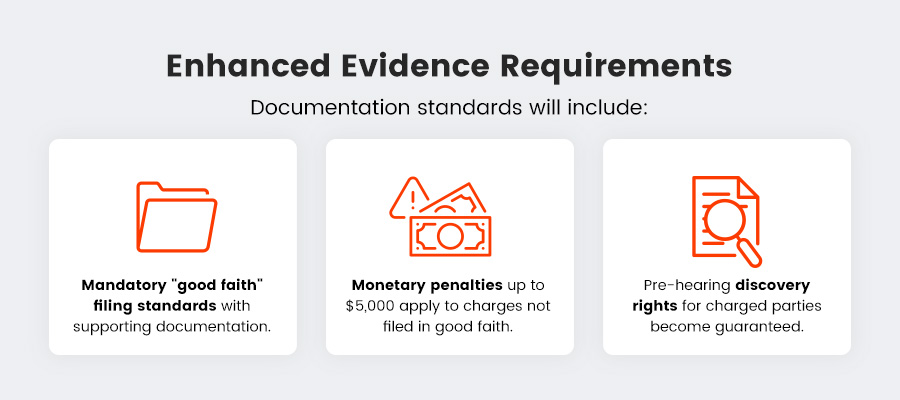
Documentation standards will include:
- Mandatory “good faith” filing standards with supporting documentation requirements for all unfair labor practice charges. Complainants must attach evidence such as affidavits, emails and photographs or provide sworn explanations detailing why documentation is unavailable and describing existing supporting evidence.
- Monetary penalties up to $5,000 apply to charges not filed in good faith or patterns of frivolous filings. These financial consequences create deterrents against using unfair labor practice charges as tactical delay mechanisms rather than legitimate dispute resolution tools.
- Pre-hearing discovery rights for charged parties become guaranteed under the legislation, allowing employers to inspect, copy and test all evidence before administrative law judge hearings. This transparency enhancement provides better preparation opportunities and may encourage earlier case resolution.
These enhanced requirements represent a significant departure from current practice, where charges can be filed with minimal supporting documentation. The new standards aim to eliminate frivolous or tactical filings that contribute to agency backlogs and delay legitimate case resolution.
Strategic Considerations for Large Employers
The likely reduction in tactical or frivolous labor practice charges benefits employers by reducing the time and resources spent defending against unsubstantiated allegations. Enhanced defense preparation opportunities through guaranteed discovery access may also improve case outcomes.
Faster case resolution timelines are possible when cases proceed on documented evidence rather than on fishing expeditions. HR departments can expect more efficient resolution of legitimate disputes while spending less time on procedural delays.
Documentation and record-keeping practices become more critical as employers prepare for enhanced discovery requirements. Companies should evaluate current documentation standards and consider improvements that support strong defense positions in potential unfair labor practice proceedings.
Preparing Your Organization for Potential Changes
There is potential for rapid implementation if the Senate votes to make the Labor Reform Package law. Follow these steps to prepare for potential updates.
1. Risk Assessment for Multi-Jurisdictional Companies
Evaluating current labor relations practices across all locations helps identify areas that may demand adjustment under potential new requirements. This assessment should include reviewing election procedures, documentation standards and unfair labor practice response protocols:
- Circuit-specific legal landscape analysis becomes essential for companies operating across multiple federal jurisdictions. Understanding how different circuits interpret labor law helps predict implementation challenges and opportunities under the NLRB Stability Act’s circuit-specific requirements.
- Union activity assessment and election preparedness evaluation should occur regularly, particularly given the Worker RESULTS Act’s emphasis on secret ballot elections and higher participation thresholds. Companies should assess their current readiness levels and develop standardized response capabilities.
- Documentation and record-keeping policy reviews ensure compliance with potential Fairness in Filing Act requirements. Enhanced evidence standards require robust documentation practices that support strong defense positions in unfair labor practice proceedings.
2. Proactive Compliance Strategies
Monitoring legislative developments and passage likelihood helps HR teams prepare appropriate response timelines. While passage remains uncertain, staying informed about political developments enables proactive, rather than reactive, compliance planning:
- Updating policies and procedures in anticipation of changes allows for systematic implementation rather than rushed adjustments. Companies can develop draft policy revisions and implementation plans that activate quickly if legislation passes.
- Training management teams on potential changes ensures consistent application of new requirements across all locations. Standardized training programs become particularly important for multilocation companies requiring uniform compliance approaches.
- Partnering with compliance experts provides ongoing monitoring and guidance throughout the legislative process. Professional compliance services help interpret complex regulatory changes and develop implementation strategies tailored to specific business operations.
3. Partner With a Dedicated Compliance Expert
When regulatory shifts like these occur, companies need more than just basic compliance. They need a strategic partnership.
At Poster Compliance Center, our 30+ years of unwavering focus on labor law posters means we understand how federal changes impact workplace posting requirements across complex, multi-jurisdictional operations. Our customized solutions and dedicated account managers ensure personalized support throughout regulatory transitions, helping enterprise clients maintain consistent compliance standards nationwide.
Poster Compliance Center Helps Navigate Regulatory Uncertainty
The complexity of tracking federal, state and local labor law developments, combined with the demands of managing day-to-day HR operations, makes it challenging for even the most experienced teams to stay current. At Poster Compliance Center, we handle all compliance updates so you can focus on your business’s requirements. Our dedicated account managers and Annual Compliance Plans provide the personalized support your organization needs to maintain consistent compliance across all locations.
Use our Poster Code Checker to verify your current compliance status, and explore our comprehensive solutions, including compliance plans, digital platforms and customized poster options designed specifically for businesses of all sizes. Our team of friendly experts is ready to assist with custom orders and provide the strategic guidance that distinguishes us as your dedicated compliance partner.
Request your free custom corporate compliance quote today.