
While many HR leaders might assume Michigan law mandates meal and rest breaks for all employees, the reality is more nuanced. This misconception leads to confusion and compliance gaps, particularly when federal rules like the Fair Labor Standards Act, enforced by the Wage and Hour Division, also govern employee breaks.
The state’s break requirements vary significantly based on employee age and individual circumstances. The civil penalties for FLSA violations can reach thousands of dollars per infraction, making it crucial to understand which regulations apply to your workforce.
Purchase the Michigan Labor Law Poster Now
In this article
- Michigan Break Laws for Adults
- Michigan Break Laws for Minors
- What Are the Other Federally Mandated Breaks?
- How to Create a Compliant Break Policy
- The Challenge of Manual Compliance Tracking
Michigan Break Laws for Adults
Break requirements for adult employees in Michigan are subject to state and federal regulations. The state adopts a hands-off approach for workers aged 18 and over, but federal rules still govern how to handle voluntarily provided breaks.
Meal and Rest Breaks
State law does not mandate rest or meal breaks for employees aged 18 and older. Employers retain full discretion to decide whether to provide breaks, their duration and their scheduling.
Unlike states with mandatory break laws, Michigan defers these decisions to employer policy. However, if you choose to provide breaks to adult employees, you must comply with federal payment rules.
FLSA Rules for Paid and Unpaid Breaks
When you voluntarily provide breaks, you must follow the federal FLSA guidelines for compensation. The FLSA distinguishes between short rest periods and longer meal breaks based on duration and the employee’s freedom from work duties.
- Short breaks: Rest periods between five and 20 minutes long are compensable work time. You must pay employees, even if they step away from their workstations.
- Meal breaks: Meal periods of 30 minutes or longer may be unpaid if the employee has no duties and is free to use the time for personal purposes.
- Compensable meal periods: If you require an employee to remain on call, monitor equipment or respond to customer needs during a meal break, that time is compensable.
Michigan Break Laws for Minors
While the state doesn’t mandate breaks for adult workers, strict requirements apply to employees under age 18. These protections ensure young workers receive adequate rest during their shifts.
Youth Employment Standards Act
The Youth Employment Standards Act is the notable exception to the state’s otherwise permissive break approach. Employers must provide minors with a 30-minute break for every five hours worked. This requirement applies regardless of industry or job type.
The break must occur before the minor completes five hours of work. Scheduling it at the four-hour mark ensures compliance and operational flexibility. This requirement is mandatory, unlike adult break provisions.
Violations of YESA can result in penalties from the Michigan Department of Labor and Economic Opportunity.
What Is an Uninterrupted Break?
To satisfy YESA requirements, minors must be fully relieved of all duties during their break. An “uninterrupted” break means the employee performs no work-related tasks during the 30 minutes. If a minor answers phones, monitors equipment or assists customers during their break, that time does not count toward the mandatory 30 minutes.
If work duties interrupt a break, you must restart the clock and provide a full, uninterrupted 30 minutes, paid as working time.
Consider implementing a system that requires minors to sign logs or use time-tracking software that records the start and end times of breaks.
What Are the Other Federally Mandated Breaks?
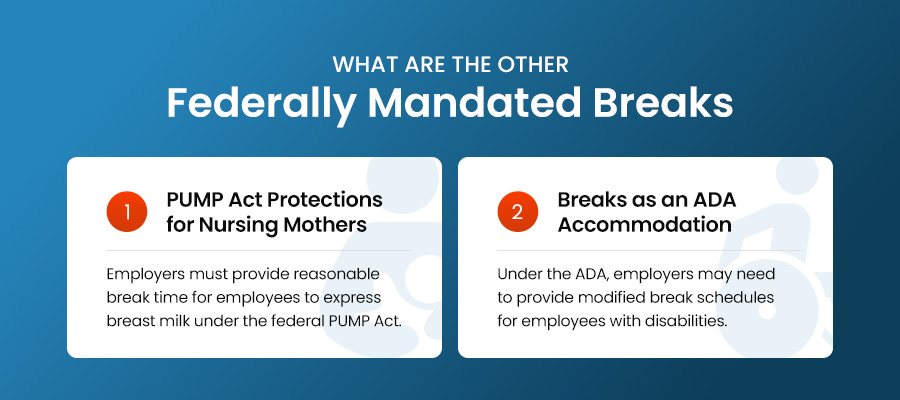
Beyond standard meal and rest periods, federal law requires specific break accommodations for some employees. These protections ensure that workers with unique needs can perform their jobs while maintaining their health and well-being.
PUMP Act Protections for Nursing Mothers
Employers must provide reasonable break time for employees to express breast milk under the federal PUMP Act. This protection applies for one year following the child’s birth and covers hourly and salaried employees.
The frequency and duration of breaks vary based on individual needs, but 15 to 30 minutes every three to four hours is typical. These breaks may be unpaid if the employee has no duties, though many employers choose to provide paid time.
Additionally, employers must provide a private space for milk expression. This location must be functional, readily available when needed and not a bathroom.
- Private space: A private office, unused conference room or designated lactation space.
- Basic amenities: A chair, flat surface and an electrical outlet for pump equipment.
- Accessibility: Available whenever the employee needs to express milk.
Employers with fewer than 50 employees may claim undue hardship if providing space or time creates significant difficulty or expense.
Breaks as an ADA Reasonable Accommodation
The Americans with Disabilities Act may require employers to provide modified break schedules as a reasonable accommodation for employees with disabilities. The ADA allows for adjustments to break schedules to help employees manage medical conditions.
- Examples of accommodations: These include additional breaks for employees who need to check their blood sugar levels, take medication or manage chronic pain. Frequency and duration depend on the employee’s documented medical needs and job requirements.
- Accommodation process: The accommodation process begins when an employee requests a modification. You should engage in an interactive dialogue to understand the medical basis for the request and explore potential solutions. Documentation from a health care provider establishes the need and appropriate parameters.
- Reasonable accommodations: Modified breaks must be reasonable and not create undue hardship for your operations. You can explore alternative accommodations if an employee’s request conflicts with essential job functions or creates safety concerns.
How to Create a Compliant Break Policy
Even without legally mandated breaks, a written policy protects your organization and its employees. Comprehensive policies prevent misunderstandings, ensure consistent application and demonstrate good-faith compliance efforts.
Develop a Written Policy
A written break policy establishes expectations and serves as documentation of fair employment practices. It also protects your organization during audits or disputes by demonstrating compliance and consideration for employee welfare.
- Consistency: Ensures uniform break practices across managers and locations.
Equal treatment: Promotes fairness regardless of shift or department. - Risk reduction: Minimizes the likelihood of discrimination claims.
- Workplace trust: Builds confidence through clear communication of expectations and protections.
What to Include in Your Break Policy
Your policy should address several elements to ensure clarity.
- Break duration and timing: Specify length and scheduling for different employee categories.
- Payment status: Define paid and unpaid breaks, including the conditions that determine compensation.
- Accommodation procedures: Include steps for requesting accommodation-related breaks, with guidance on documentation requirements and the interactive process.
- Minor employee protections: Dedicate a section to YESA requirements and the specific 30-minute break mandate for workers under 18.
- Practical guidelines: Address where employees may take breaks, whether they must remain on the premises and how to handle emergency callbacks during unpaid meal periods.
Mistakes to Avoid
Avoid these frequent errors that create compliance risk.
- Automatic deductions: Many employers deduct meal breaks without confirming that employees officially stepped away from work. When someone works through lunch or gets pulled back into a task, that time counts as work and the employer must pay for it.
- One-size-fits-all policies: Maintaining identical break policies for adult employees and minors violates YESA. Your policy must explicitly address the mandatory 30-minute break for workers under 18.
- On-call requirements: Requiring employees to remain on call during unpaid breaks creates compensability issues. If an employee must monitor their phone, respond to emails or be immediately available, the break time is compensable under FLSA standards.
The Challenge of Manual Compliance Tracking
Creating a compliant break policy is only one element of workplace compliance. As regulations evolve at state and federal levels, staying current with all mandatory requirements becomes increasingly complex. Additionally, laws vary across states, making manual compliance management risky.
When regulations update, immediate awareness and action are necessary. Manual tracking involves monitoring multiple regulatory agencies, interpreting legal updates and ensuring every location reflects current requirements.
This burden multiplies for organizations with multiple facilities or those operating across state lines. Fortunately, Poster Compliance Center eliminates headaches. Our Annual Compliance Plan ensures you receive automatic updates whenever state labor laws change, so your workplace consistently displays the most current notices.
With over 30 years of experience and a proven track record, we handle compliance in your Michigan workplace and give you peace of mind.