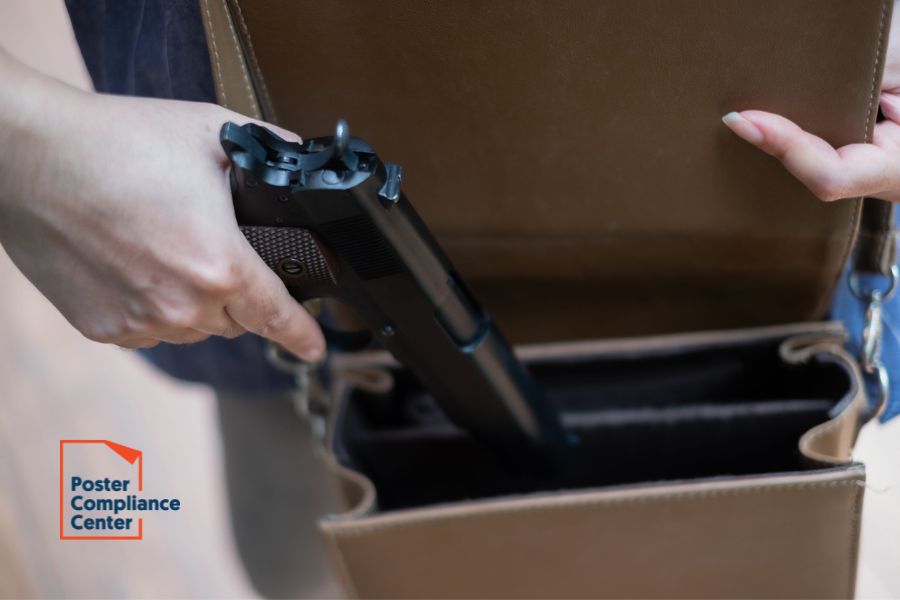

When it comes to firearms and the workplace, employers walk a fine line between respecting employee rights and maintaining a safe environment. One of the most common questions human resources leaders ask is whether employees are allowed to bring guns to work—and the answer depends heavily on the state where your business operates.
In this article, we’ll explore state laws that govern whether employees are permitted to have weapons at the worksite.
In this article
- Firearm Bans in the Workplace
- Understanding “Bring Your Gun to Work” and Parking Lot Laws
- Industry Exceptions and Federal Considerations
- Best Practices for Employers
Firearm Bans in the Workplace
No state laws restrict private employers from prohibiting guns inside buildings, offices, and other work areas. Private employers that wish to prohibit firearms in these states should post a notice to that effect:
|
|
Understanding “Bring Your Gun to Work” and Parking Lot Laws
In recent years, many states have passed what are commonly known as “parking lot laws” or “bring your gun to work” laws. These laws typically allow employees with valid permits to keep firearms locked in their personal vehicles on company property, even if the employer has a policy banning firearms in the workplace.
As of 2025, the following states allow employees to store firearms in their vehicles on company property:
|
|
Generally, these laws require the employee to lawfully own and carry the firearm and for the firearm to be stored in a locked vehicle and kept out of plain view.
A few states have no explicit parking lot laws but may offer some protections under court rulings or general firearm statutes. In these states, employer rights and employee gun rights exist in a gray area. For example, in Pennsylvania, some court decisions have sided with employees storing guns in vehicles. And in South Carolina, limited protections exist for employees keeping firearms in locked vehicles.
Employers in these states should be especially cautious and consult with legal counsel when drafting workplace weapons policies.
Industry Exceptions and Federal Considerations
Even in states with strong employee firearm protections, businesses in certain industries must comply with stricter federal rules, including educational institutions, federal contractors, healthcare facilities, and government employers.
- Educational institutions are governed by the federal Gun-Free School Zones Act.
- Federal contractors may be subject to regulations issued by the General Services Administration (GSA) or other federal agencies that prohibit firearms on federal property.
- Healthcare facilities, especially those handling behavioral health or funded through Medicare or Medicaid, may follow additional safety regulations that prohibit weapons.
- Government buildings typically fall under federal or state bans that prohibit civilians from carrying firearms on premises.
Keep in mind that federal and state regulations may overlap, so employers in these sectors should confirm which laws take precedence.
Best Practices for Employers
Whether you’re in a state with strict controls or broad gun rights, it’s essential to have a workplace weapons policy. A well-drafted workplace weapons policy should accomplish the following:
- Clearly define what constitutes a “weapon”
- State whether firearms are allowed on the premises or in vehicles
- Outline disciplinary actions for violations
- Address how the company will handle searches or reports of weapons
- Reference state-specific laws or exceptions
- Be acknowledged in writing by employees (e.g., signed during onboarding)
Take these additional steps to strengthen your compliance:
- Know your state’s law: Multi-state employers must track firearm laws across all locations.
- Be clear about the scope of your policy: Your firearms policy should distinguish between prohibiting firearms inside the building versus allowing secure storage in vehicles.
- Balance safety and legal rights: Aim for policies that support safety without unintentionally violating employee rights under state law.
- Train supervisors: Ensure management understands how to enforce the policy while remaining compliant.
- Update employee handbooks and signage: Communicate your weapons-related policies to employees and ensure you meet any labor law posting requirements.
- Work with legal counsel: Especially when expanding into new states or industries, consult attorneys familiar with federal, state, and local firearms laws.
Laws around weapons in the workplace are just one part of a broader compliance picture. At Poster Compliance Center, we help employers stay up to date on workplace notice requirements and policy changes in all 50 states.
Contact us to learn how we can support your HR team with the latest labor law posters, compliance updates, and more.