
If you’re managing labor law compliance for multiple locations, paternity leave regulations likely eat up much of your workload. The U.S. doesn’t mandate paid leave at the federal level, leaving you to coordinate an expanding patchwork of state and local laws that differ widely in their requirements.
You’re tracking varying wage replacement rates, leave durations and eligibility rules across every jurisdiction where you have employees. To keep your organization compliant and your team informed, you’ll need a solid grasp of both the federal protections under the Family and Medical Leave Act of 1993 (FMLA) and the state programs that go beyond that baseline.
In This Article
- Paternity Leave Laws in the U.S.
- How FMLA Applies to Paternity Leave
- Best Practices for Your Leave Policy
- Keep Paternity Leave Postings Compliant With Poster Compliance Center
Paternity Leave Laws in the U.S.
The U.S. paternity leave system operates on two levels. At the federal level, FMLA gives eligible employees unpaid, job-protected leave. However, because FMLA leave is unpaid, it often places a financial burden on new parents who may not be able to afford to take time off.
State programs have emerged to fill this gap, with a growing number of jurisdictions implementing mandatory paid family leave systems funded through social insurance models. The gap between federal protections and state-led innovation means your strategy should account for both the FMLA baseline and specific requirements in every jurisdiction where you operate.
States With Mandatory Paid Leave Programs
As of early 2026, 14 states and the District of Columbia have enacted mandatory paid family leave laws. They mandate employer contributions and provide wage replacement for eligible employees who take time off to bond with a new child. Some programs are employer-funded, while others are employee-funded or use a mixed payroll contribution.
AWW = Average Weekly Wage
| State | Leave Duration | Wage Replacement % | Max Weekly Benefit | Employee Eligibility Requirements |
|---|---|---|---|---|
| California | Up to 8 weeks | 60-70% | $1,620 | Worked at least one year and at least 1,250 hours within the last year. |
| Colorado | Up to 12 weeks | 90% (up to 50% AWW) | $1,100 | Earned $2,500 over the previous year for work performed in Colorado. |
| Connecticut | Up to 12 weeks | 95% (up to 60% AWW) | $902 | Worked for a business with one or more employees working in Connecticut. |
| Delaware | Up to 12 weeks | 80% | $1,000 | Worked for at least one year and at least 1,250 hours with an employer with a minimum of 10 employees. |
| District of Columbia | Up to 12 weeks | 90% | $1,148 | Worked for current employer for one year and at least 1,250 hours in the previous 12 months. |
| Maine | Up to 12 weeks | 90% (up to 65% AWW) | $1,191 | Earned six times the state AWW over the previous 12 months. |
| Maryland | Up to 12 weeks (from July 1, 2026) | 90% (up to 65% AWW) | $1,300 | Worked at least 680 hours in Maryland in the four quarters before their leave. |
| Massachusetts | Up to 12 weeks | 80% (up to 64% AWW) | $1,192 | Earned at least $6,300 during the last year or at least 30 times the weekly benefit. |
| Minnesota | Up to 12 weeks | 90% (up to 55% AWW) | $1,300 | Earned at least $3,900 over the previous 12 months. |
| New Jersey | Up to 12 weeks | 85% (up to 70% AWW) | $1,055 | Worked for New Jersey employers who contribute to the state plan for family leave insurance or an approved private plan. |
| New York | Up to 12 weeks | 67% | $1,151 | Worked full-time over 26 consecutive weeks or part-time after 175 days of employment. |
| Oregon | Up to 12 weeks | 100% (up to 120% AWW) | $1,474 | Earned at least $1,000 in the year before their leave. |
| Rhode Island | Up to 6 weeks | 60-80% | $1,100 | Worked in Rhode Island if they pay into the state’s temporary caregiver insurance fund. |
| Washington | Up to 12 weeks | 90% (up to 50% AWW) | $1,526 | Worked 820 hours in Washington over 12 months before their leave. |
| Virginia | Up to 12 weeks (from December 1, 2028) | 80% | $1,507 | Earned at least $3,000 over the two highest-earning quarters in the designated base period. |
States With Voluntary Paid Leave Programs
Nine states have created opt-in programs through private insurance. Alabama, Arkansas, Florida, Kentucky, New Hampshire, South Carolina, Tennessee, Texas and Vermont let employers participate voluntarily. The programs are optional, but they can serve as a middle-ground solution for employers who want to offer paid leave without waiting for a state mandate.
Keep in mind that even within states, city-level compliance laws can add another layer of requirements to track.
How FMLA Applies to Paternity Leave
FMLA is the federal foundation for parental protections. It provides eligible workers in covered companies up to 12 weeks of unpaid, job-protected time off during a 12-month period to bond with and care for a newborn, adopted or foster child.
It guarantees job security and continued health benefits during their leave. The law applies to both parents, ensuring paternity leave receives the same job protection as maternity leave under federal law.
Employee Eligibility Requirements for FMLA
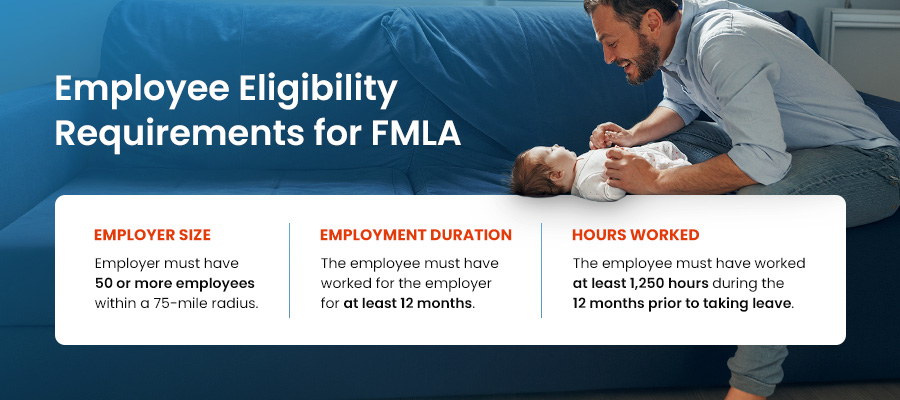
Not all employees qualify for FMLA protections. To be eligible, employees must meet three criteria:
- Employer size: The employer must have 50 or more employees within a 75-mile radius.
- Employment duration: The employee must have worked for the employer for at least 12 months.
- Hours worked: The employee must have worked at least 1,250 hours during the 12 months prior to taking leave.
Do these requirements apply to you? They’ll determine whether your organization is covered and which employees qualify for FMLA leave. Managing compliance across multiple sites means you’ll need to track eligibility on a site-by-site basis since the 50-employee requirement applies by location radius, not company-wide headcount. Ensure you have the required Family and Medical Leave Act poster displayed in each covered location.
FMLA Provisions for New Parents
When an eligible employee takes FMLA leave for the birth or placement of a child, the law offers three key protections:
- Leave duration: Up to 12 workweeks of leave during a 12-month period.
- Job protection: Employers must restore employees to the same position or an equivalent job with the same pay, benefits and working conditions upon return.
- Health benefits: Employers must maintain group health insurance coverage during the leave period under the same terms as if the employee had continued working.
These protections hold whether the employee receives wages during time off or not. In states with paid family leave systems, workers may receive wage replacement through the state while still relying on FMLA for job protection and benefits continuation.
Best Practices for Your Leave Policy
Building a paternity leave policy that supports your employees and maintains compliance takes thoughtful planning and clear communication.
Consider these options:
- Stay current with state laws: Keep your policies aligned with state-mandated paid leave laws in every jurisdiction where you operate. If you’re managing multiple states, consider creating a uniform policy that meets or exceeds the most generous state requirements to simplify administration.
- Offer paid leave as a benefit: Even where not legally required, paid paternity leave can improve recruitment and retention. Many companies now offer two to 12 weeks of paid paternity leave as a standard benefit.
- Adopt gender-neutral parental leave policies: Structure policies so they apply to all parents, regardless of gender. Gender-neutral policies encourage fathers to take leave without affecting their careers.
- Communicate policies to all employees: Proactively inform employees about their leave options, eligibility requirements and state-specific programs. Many employees don’t know what’s available to them.
- Build a supportive culture: Research from the World Health Organization emphasizes the importance of father engagement in early infant care for maternal and child health outcomes. Encourage male employees to take paternity leave.
- Consider voluntary programs: In states without mandatory paid leave, offering access to voluntary paid leave through private insurers demonstrates your commitment to work-life balance.
Staying ahead of labor law trends and regularly reviewing your policies keeps you compliant as regulations evolve.
Keep Paternity Leave Postings Compliant With Poster Compliance Center
Managing the intersection of federal, state and local leave laws can be challenging for HR teams, especially when coordinating across multiple jurisdictions. Poster Compliance Center simplifies this challenge by keeping your organization up to date with all required labor law postings, including family and medical leave notices.
Our State and Federal Compliance Plan sends automatic updates as mandatory laws change, backed by our compliance guarantee. Our custom support and solutions offer tailored management for organizations with complex, multi-state needs.
Let us keep your posters up to date so you can focus on supporting your team.