
Navigating the latest, often complex state-specific labor laws can be challenging for any HR or compliance professional. Two workplace violence prevention laws in California and New York require a deep understanding and effective implementation. Businesses must stay up to date on the evolving legal landscape and implement the necessary prevention and reporting measures to foster a safe working environment.
We will provide a clear, actionable breakdown of the latest workplace violence prevention laws in both California and New York so you can ensure your business is protected. Discover the impacts of California’s SB 553 and New York’s Retail Worker Safety Act on your business and take strategic steps to keep your business and workforce compliant.
In This Article:
- Understanding California’s Workplace Violence Prevention Law
- Understanding New York’s Retail Worker Safety Act
- Actionable Steps for HR Leaders to Ensure Compliance
- Stay Compliant With Poster Compliance Center
Understanding California’s Workplace Violence Prevention Law
California’s workplace violence prevention law, SB 553, went into effect on July 1, 2024. It includes comprehensive requirements to ensure safer work environments across all industries. It emphasizes the importance of involving employees in creating and implementing workplace violence prevention plans, fostering a collaborative approach to addressing workplace violence.
In April of 2026, Cal/OSHA released a revised draft standard that closed for comments on June 1, 2026.
Key Requirements
The cornerstone of SB 553 is the Workplace Violence Prevention Plan (WVPP). All California employers must develop a WVPP, which businesses can incorporate into their existing Injury and Illness Prevention Plan or maintain as a separate document. This plan must be in writing and site-specific, addressing the unique risks of each location.
The plan must include the following information:
- The names of persons responsible for its implementation
- Effective procedures for employee involvement in developing and implementing the plan
- Methods to coordinate the implementation of the plan with other employers, if applicable
- Procedures for employers to handle and respond to reports of workplace violence
- Procedures to ensure employee compliance
- Procedures for communicating with employees regarding workplace violence matters
Employee Training Mandates and Violent Incident Logs
Training ensures that employees are always up to date on how to recognize, prevent and respond to violent situations in the workplace. Under SB 553, employers must provide comprehensive training when they first implement WVPP and offer annual refreshers. This training must also be refreshed following the identification of new risks or changes to the WVPP.
Finally, employers must establish clear reporting procedures for workplace violence incidents. All incidents, regardless of severity or injury, must be documented in a Violent Incident Log, which employers must maintain for at least five years. The violent incident log must document every incident, including the type of violence and response, without containing personally identifiable information.
Who Is Covered by SB 553?
California’s SB 553 law applies to almost all California employers. There are a few specific exemptions, including:
- Healthcare facilities already covered by a different standard
- Certain public-inaccessible worksites with fewer than 10 employees
- Employees teleworking from a location of their choice
At Poster Compliance Center, we understand that running a business is hard work and staying in compliance shouldn’t be. Our California labor law poster subscription includes free mandatory poster updates and a dedicated account representative.
Understanding New York’s Retail Worker Safety Act
On September 4, 2024, New York Governor Kathy Hochul signed the New York Retail Worker Safety Act into law. The law focuses on increasing safety in the retail industry. The New York Retail Worker Safety Act adds Section 27-E to the existing New York Labor Law.
Key Requirements
Employers must either adopt the model policy provided by the New York Department of Labor or establish their own that meets or exceeds the minimum standards. Full compliance involves creating a workplace violence prevention policy to proactively ensure employee safety.
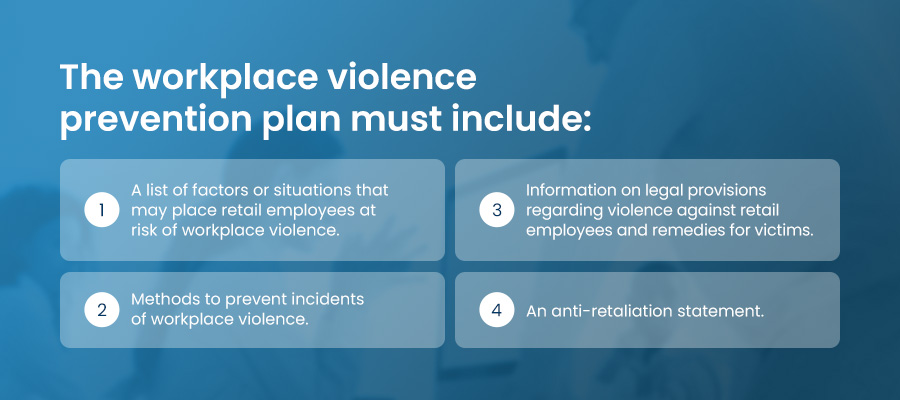
The workplace violence prevention plan must include:
- A list of factors or situations that may place retail employees at risk of workplace violence.
- Methods to prevent incidents of workplace violence.
- Information on legal provisions regarding violence against retail employees and remedies for victims.
- An anti-retaliation statement.
Mandatory Employee Training and Silent Response Buttons
Employers must also provide new hires with training on topics that include de-escalation techniques, active shooter drills, emergency procedures and instructions on using security alarms, silent response buttons and other emergency devices.
Additionally, employers with 500 or more retail employees nationwide must provide employees with access to silent response buttons in the workplace or a company-issued wearable by January 1, 2027. These buttons contact security personnel, management or supervisors.
Who Is Covered by the Retail Worker Safety Act?
New York’s Retail Worker Safety Act applies to retail employers with 10 or more employees. A retail store sells consumer commodities at retail and does not sell food for consumption on the premises.
Retail stores may require assistance in identifying policy changes and implementing compliance strategies. To receive free, mandatory posted updates when laws change, sign up for our New York labor law poster subscription service and stay compliant.
Actionable Steps for HR Leaders to Ensure Compliance
Implementation is the key to compliance with ever-changing labor laws. Discover our high-level checklist, a practical guide to getting started with operationalizing the workplace violence laws in California and New York.
1. Assess Your Current Policies and Procedures
Perform a gap analysis, comparing your existing safety and violence prevention plans against the specific requirements of the latest laws in the states where you have employees. A thorough analysis will identify opportunities for improving your compliance.
2. Develop and Implement Your State-Specific Plans
A one-size-fits-all approach is often insufficient, since most businesses have specific compliance needs. Employers must customize their plans and policies to meet the unique requirements of each state and the specific hazards of each worksite. Our eComply360™ platform lets remote and hybrid employees access and download the latest, accurate labor law posters for their location.
3. Train Your Employees and Document Everything
Schedule and conduct the required training and be meticulous about maintaining your violent incident logs and training records. Remember that compliance requires continuous adherence to guidelines and regular updates to employee-facing communications about labor laws.
We provide you with the mandatory posters you need for all your locations to stay compliant with the latest labor law updates.
Stay Compliant With Poster Compliance Center
Staying on top of complex, evolving labor laws is a large task for any HR department, but you can partner with Poster Compliance Center to make it easier. Our services — from state and federal poster plans to corporate compliance solutions — ensure businesses have the correct, up-to-date postings to gain peace of mind and free up HR leaders’ time. We take care of your compliance needs so you can take care of your business.
Contact us today to speak to a labor law expert or request a custom quote for your unique compliance needs.