
Due to the popularity of remote work, lawmakers at the state level have begun to mandate or recommend a digital, verifiable compliance strategy for remote teams. Fully complying can be difficult for multi-state companies. If standards are broken in even a single state, it can lead directly to fines, lawsuits and reputation damage.
Overcoming multi-state remote poster compliance risk is not always easy, but it is possible. First, your company needs an understanding of the complexity of labor law compliance by state. Then, you need a system that simplifies compliance for your HR teams and reduces executive-level liability.
Learn about the states with digital poster laws and how compliance services make it easier to avoid liability issues.
Shop Our Digital Compliance Solutions
In This Article
- The Federal Baseline for Labor Law Posters
- The 2026 State-by-State Digital Poster Mandates
- Why Passive Intranets and Manual Methods Fail the Compliance Test
- The Centralized Solution and Audit Defense
The Federal Baseline for Labor Law Posters
The U.S. Department of Labor (DOL) has poster requirements that apply to all 50 states. While the states also have their own posters and guidelines, the federal guidelines must still be followed to avoid compliance issues.
These posters are required in almost every workplace:
- An “Employee Rights Under the Fair Labor Standards Act” poster informs employees about minimum wage, overtime pay and other standards established by the Fair Labor Standards Act (FLSA).
- A “Job Safety and Health: It’s the Law” poster informs employees about the safe and sanitary workplace standards established by the Occupational Safety and Health Act.
- An “Employee Rights and Responsibilities Under The Family and Medical Leave Act” poster informs employees about the standards for leave established by the Family and Medical Leave Act.
Some companies may also need to post or send the following posters to their employees, if they meet the posting requirements:
- An “Employee Polygraph Protection Act” notice informs commercial employees about the standards for polygraph use established by the Employee Polygraph Protection Act.
- A “Migrant and Seasonal Agricultural Worker Protection Act” notice informsmigrant and seasonal agricultural employees about the many employment standards related to housing, wages, transportation and other issues established by the Migrant and Seasonal Agricultural Worker Protection Act.
- An “Employee Rights for Workers with Disabilities Paid at Special Minimum Wages” poster informsemployees with disabilities informed about the special minimum wage standards established by the FLSA.
- A “Your Rights Under USERRA” notice/poster informs veteran employeesabout their employment rights, as established by the Uniformed Services Employment and Reemployment Rights Act.
- An “Employee Rights Under the H-2A Program” poster informsemployees with H-2A visas about their rights, as established by the Immigration and Nationality Act.
Find a complete list of the posters and notices your company must display via the DOL’s FirstStep Poster Advisor.
All necessary posters and notices must be placed in an accessible location where all in-person employees can see them. For remote or hybrid employees, digital posters must be available at all times, without requiring special permissions. Notify employees that the posters are available. Ensure the system provides a read receipt to prove all employees have been notified. These steps create a legal safe harbor for DOL electronic delivery, as per 29 CFR § 2520.104b-31.
Many employers rely on emails or a shared company drive for legally compliant e-delivery of labor law posters. Unfortunately, these systems can be slow to adapt and cumbersome to use. Poster Compliance Center can equip your company with all the latest digital labor law posters through our yearly subscription program. This program is designed to keep your company in compliance, even when federal and state standards change.
The 2026 State-by-State Digital Poster Mandates
States have labor laws separate from those set by the federal government. These laws come with their own postings and rules governing how and where those postings are placed.
Some states have also developed poster legislation for remote or hybrid employees. Others have no guidelines in this area. For example, Maine labor law posters are required for workplaces, but there isn’t specific guidance on making them digitally available.
More states will likely address this legislative gap in the future. For now, the state-specific digital posting rules as of 2026 are listed below.
States With Firm Digital Poster Mandates
The following states have laws explicitly mandating the use of digital labor law posters for remote workers:
- New York: Labor Law § 201 states that employers must provide their employees with digital copies of posters via email or through their website. This rule applies whether companies have remote/hybrid employees or not. New York digital labor law posters cover blood donation leave, criminal conviction records and many other labor standards.
- Illinois: IllinoisHouse Bill 3733 makes digital posters mandatory for all employers whose employees work from home or while traveling. These Illinois digital labor law posters inform employees about the Paid Leave for All Workers Act, the Worker Freedom of Speech Act and more.
- Rhode Island: The Rhode Island Department of Labor and Training requires employers to send their remote/hybrid workers the Required Posters for the Workplace via text or email. Rhode Island digital labor law posters provide information on the Healthy and Safe Families and Workplaces Act, the Pay Equity Act and more.
- Colorado: Employers are required to let their employees know about the Colorado Overtime and Minimum Pay Standards and the Family and Medical Leave Insurance Program. Colorado digital labor law posters include many other labor standards, as well.
- Oregon: The Paid Leave program requires employers to provide remote employees with a digital copy of the Paid Leave Oregon poster. Other Oregon digital labor law posters cover sick time, workplace accommodations and more.
- Washington: The Washington Department of Labor and Industries states that employers must provide remote employees with either a physical copy of the required posters or a link they can use to print said posters. Digital copies may also be provided. Other Washington digital labor law posters inform employees about workers’ compensation, paid time off and other benefits.
- New Mexico: The New Mexico Department of Workforce Solutions allows employers to send remote employees a digital copy of the required posters through electronic means. Many employers use email, but posters can also be posted on the company’s website. New Mexico digital labor law posters cover discrimination, minimum wage and other standards.
- Arizona: The Arizona Department of Administration Human Resources advises employers to provide electronic access to any required workplace posters for all staff, including remote workers, as mandated by various laws. Arizona digital labor law posters concern workplace discrimination, employee rights, fair pay and more.
Following state laws mandating electronic labor law notices is easy with Poster Compliance Center. We take care of your compliance needs so you can take care of your business. We even update your posters for free when legislation changes as part of our yearly subscription program.
States With Permissive Digital Poster Standards
The following states allow digital posters in addition to physical posters:
- California: Senate Bill No. 657 states that employers can distribute the required posters through email, but they are still required to place physical postings in an accessible part of the workplace. California digital labor law posters cover time off to vote, whistleblower protections and other standards.
- New Jersey: New Jersey Administrative Code 13:8-1.2 allows employers to post the required Law Against Discrimination employment poster on their internet or intranet site if preferred. Other New Jersey digital labor law posters include the New Jersey Family Leave Act poster and the New Jersey Gender Equity poster.
- Ohio: Ohio Senate Bill 33 allows employers to upload certain required posters to the internet if preferred, so long as employees can access them easily. Ohio digital labor law posters cover minor labor laws, minimum wage and more.
If your company conducts business in multiple states, it can be difficult to adhere to all the necessary electronic labor law poster requirements. Poster Compliance Center can simplify things with our poster services and robust digital compliance platform. Together, they protect your company from compliance violations, saving time and money.
Why Passive Intranets and Manual Methods Fail the Compliance Test
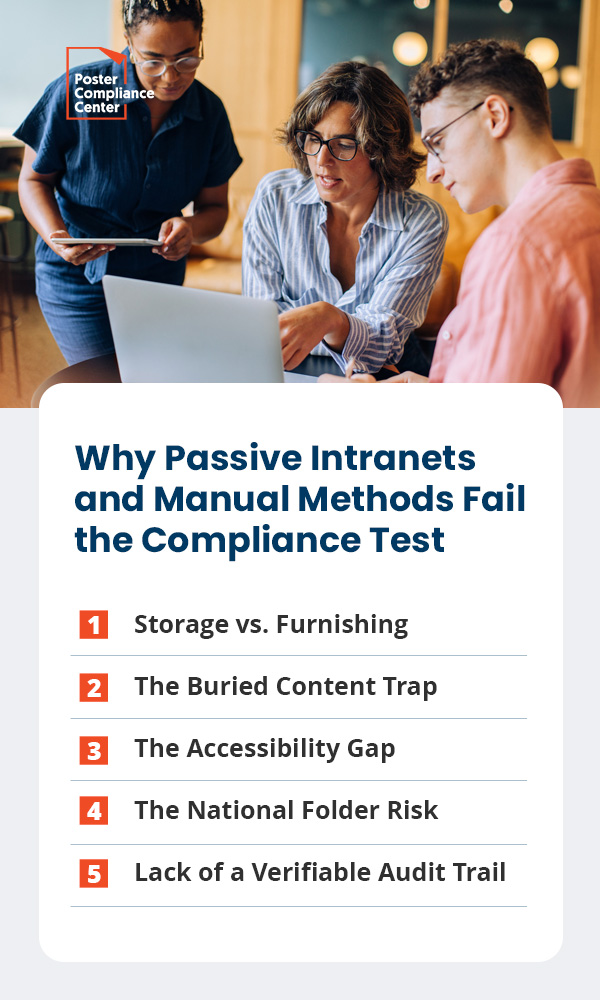
Not all approaches to digital compliance are created equal. While many companies use email or a static intranet folder to dispense the required posters to their employees, these approaches struggle to adhere to state-specific digital labor law poster requirements. They can also lead to obstructions, passivity and even compliance violations in some cases.
1. Storage vs. Furnishing
Static compliance methods, like saving a PDF to a SharePoint folder, are insufficient. They may store the relevant labor law posters, but they do not furnish them. Furnishing systems alert employees when posters change and send employers read receipts that confirm employees have seen the posters. If your system does not do either, it can lead to liability. Full state compliance in digital posting requires updated posters and compliant practices.
2. The Buried Content Trap
Posters buried five clicks deep in an intranet file or an old email could be secure, but they are not accessible. Obstructing content in this way makes it harder for employees to know and reference their rights, which can constitute a violation of labor law. Compliant solutions use direct links or single sign-on to keep posters safe and accessible.
3. The Accessibility Gap
HR teams may send digital posters as PDF scans or JPGs. This approach works for some remote employees, but these file formats often cannot be read by screen readers, making them inaccessible to those with low vision. This scenario may constitute a violation of the Americans with Disabilities Act.
To resolve this issue, your company should follow Web Content Access Guidelines to ensure digital resources are accessible for everyone.
4. The National Folder Risk
Multi-state compliance complicates intranet poster storage. Some companies may store every state’s posters in a single national folder. This process does not just make it harder for employees to find posters relevant to them. It also makes it likely that they will see other employees’ state benefits, which can lead to interpersonal issues. Separating and sorting the files can solve this problem, but it can also make the files more inaccessible to employees.
A compliant system will only show employees the posters that are relevant to them and alert them if anything changes automatically.
5. Lack of a Verifiable Audit Trail
Manual compliance methods do not leave proof of accessibility. If an employee says they never saw a poster, a standard intranet log often cannot prove otherwise. This system is unable to provide multi-state digital poster acknowledgement, but a dedicated compliance log can. A compliance log tracks when notices are sent and when documents are accessed, creating a verifiable audit trail for your company.
The Centralized Solution and Audit Defense
A centralized digital compliance platform simplifies your company’s approach to compliance. It provides verifiable employee acknowledgment of digital postings and keeps you up to date with the latest digital labor law poster requirements.
1. Executive Ease
Tracking state-by-state digital compliance requirements manually comes with significant executive risk. This workflow is difficult to scale, wastes time and makes compliance violations much more likely.
A centralized digital solution like eComply360 overcomes these hurdles with ease. It gives all employees easy access to the necessary posters in their state, and each one is updated as new legislation emerges. Your HR teams do not have to do research, sorting or updating of any kind, which saves significant time when covering multiple states. This approach also minimizes compliance risk, reducing the likelihood of fines significantly.
2. Robust Compliance Features
Digital compliance platforms should simplify all aspects of compliance, whether your teams work in person or remotely. When creating an HR compliance checklist for remote multi-state teams, include three main points:
- Automated jurisdictional mapping: State permissibility for digital labor law posters can vary across the country. A compliant platform automatically equips employees with the relevant posters based on their ZIP code.
- Active push notifications: A compliant platform lets both employers and employees know when legislation in their jurisdictions changes. It can send them a push email alert as soon as updates are made, keeping everyone in the loop and preventing compliance violations.
- Verifiable acknowledgment: Physical sign-offs are a thing of the past with a compliant platform. Instead, the platform tracks exactly when notices and posters are opened, providing concrete proof of compliance on all ends.
3. Fine Mitigation
The best digital compliance platforms defend your company from fines and litigation. They do so by creating a documented history of how the platform has been used. They track when updates are made, when notices go out and when employees interface with labor law documentation. Your company can use this information to create a timestamped access log, which you can send to auditors as proof of compliance. This process can make audits far less common and reduce the risk of expensive penalties.

Upgrade Your Company’s Compliance With Poster Compliance Center
Labor law compliance is not as simple as it used to be, especially if your company operates in multiple states. Manual downloads and static intranet folders may have been sufficient in the past, but now, they can be a financial and legal liability.
Poster Compliance Center can equip your company with a technology-driven defense strategy that maps mandates, automates updates and keeps everyone informed, wherever they are.
If your teams work from home, you can audit-proof your remote workforce with eComply360. If you run a hybrid operation, connect with our labor law experts to discuss your specific compliance challenges. We will design a custom compliance roadmap that addresses your in-person and remote teams.
Connect with our experts today!