
Staying up to date and compliant with California Labor Laws in the workplace can be challenging and high-stakes. New laws are introduced regularly, and keeping up with these changes can be time-consuming and stressful, especially when you’re not notified when these new laws come into effect. For a simpler solution to guaranteed compliance, we have the answer.
In this guide, we’ll provide a clear and easy-to-follow checklist of California labor laws and mandatory postings required in the workplace. We’ll also explain why staying compliant and up to date with postings is important and how to ensure your compliance in an ever-changing workforce.
In This Article
- Why Staying Compliant Matters
- Mandatory Federal Labor Law Postings
- Required California State-Level Labor Law Postings
- Special Requirements for Certain Industries
- Keeping up With Frequent Changes and Remote Workers
Why Staying Compliant Matters
To understand why labor law compliance is important, you need to know the penalties and consequences of noncompliance. Aside from hefty posting fines, there are also legal liability and litigation risks if a lawsuit were to arise due to the lack of recent, relevant postings available to your workforce.
The Financial Risks of Noncompliance
You can face heavy financial penalties and fines if your postings aren’t current. For example, violations of the California Consumer Privacy Act (CCPA) can cost up to $7,988 for each intentional violation. To protect your finances and company, you need to ensure that all mandatory postings are available and visible to your employees and that they’re current and relevant to your industry.
Other substantial fines and penalties can include:
- Know Your Rights Notice (SB 294): Failure to provide the required “Know Your Rights” notice or to inform employees of their right to designate an emergency contact can result in fines of up to $500 per employee per day.
- Pay transparency violations: An unprovided pay scale in job postings can lead to penalties of $100 to $10,000 per violation.
- Poster noncompliance: Failure to display updated state or federal posters can result in federal fines of up to $35,000 and state fines of up to $17,000.
On top of financial risks, you can also face legal liability and litigation risks, such as:
- PAGA claims: California’s Private Attorneys General Act (PAGA) permits employees to initiate legal proceedings on behalf of the state for labor violations, including deficient postings, which can escalate into costly lawsuits.
- Defense weakness: Missing or outdated posters can be used as evidence in disputes, making employers vulnerable to wage and hour lawsuits.
- Statute of Limitations: Deficient posting can extend the statute of limitations for employee claims.
To avoid these costly consequences of noncompliance, it’s necessary to have a compliance plan in place to protect your company. Our Annual Compliance Plan is backed by a $41,000 warranty against posting fines, ensuring that you’re protected should penalties arise.
The Importance of an Informed Workforce
While it may be a workplace obligation, posting federal and state-specific posters offers your company various nonfinancial benefits. More than keeping your business compliant, it also increases employee trust by ensuring they have access to their rights and demonstrating a commitment to a safe and fair workplace.
These nonfinancial benefits include:
- Reduced legal and regulatory risk: Displaying required posters lowers the risk of penalties and employee lawsuits.
- Employee transparency: Clearly informing employees of their rights improves morale and transparency.
- Improved safety culture: Displaying safety and health protection posters educates employees on safety standards and emergency procedures, reducing workplace hazards.
- Remote and hybrid accommodation: Using electronic postings helps ensure remote and hybrid workers have access to the same information as on-site employees.
Mandatory Federal Labor Law Postings
All California employers must display federal notices. Federal labor law posters cover national regulations, mandatory for all employers nationwide. To ensure your workplace is compliant, we’ve listed and explained each essential posting below.
Equal Employment Opportunity (EEO) Law
The Civil Rights Act of 1964 established the Equal Employment Opportunity Commission, a federal agency that protects Americans from workplace discrimination. Equal employment opportunity is required under various laws, including Title VII of the Civil Rights Act, the Americans with Disabilities Act and the Age Discrimination in Employment Act.
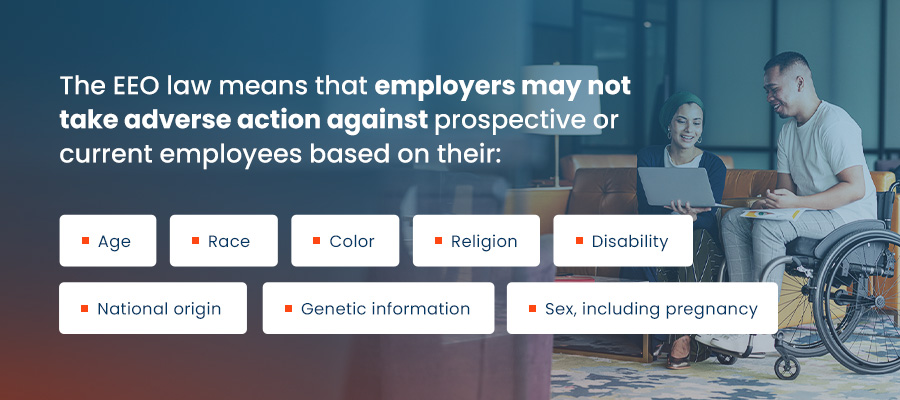
The EEO law means that employers may not take adverse action against prospective or current employees based on their:
- Age
- Race
- Color
- Religion
- Disability
- National origin
- Genetic information
- Sex, including pregnancy
To ensure awareness and compliance, employers must post the “Know Your Rights” poster. This poster also provides information about how to file complaints.
Employee Polygraph Protection Act
The EPPA prohibits private employers from requiring, requesting or suggesting that employees or job applicants take a lie detector test. Employers also cannot take disciplinary action against current or prospective employees who refuse to take a lie detector test.
Fair Labor Standards Act (FLSA)
The FLSA provides minimum wage, overtime eligibility and recordkeeping standards. These FLSA standards govern private employers and federal, state and local government employers. The federal minimum wage remains at $7.25 per hour in 2026.
The FLSA has posting requirements for provisions within the act, including minimum wage information. Many state governments require additional posters regarding minimum wage and overtime pay, among other wage and hour topics.
Family and Medical Leave Act (FMLA)
The FMLA covers all public employers, all public and private elementary and secondary schools and private companies with 50 or more employees to foster a healthy work-life balance and equal employment opportunity.
The FMLA requires covered employers to grant eligible employees up to 12 weeks of unpaid leave under certain circumstances, including the following:
- The birth and care of an employee’s newborn child.
- The adoption or foster care placement of a child with an employee.
- To care for an employee’s immediate family member who has a serious health condition.
- To take medical leave for a serious health condition that renders an employee unable to work.
The FMLA requires employers to display a poster outlining the employee leave entitlements, benefits, protections and eligibility requirements provided in the act.
Occupational Safety and Health Administration (OSHA)
The Occupational Safety and Health Act created OSHA to ensure safe and healthful working conditions. OSHA sets and enforces standards by providing training, outreach, education and compliance assistance through cooperative and voluntary programs.
All public and most private employers must provide a safe work environment for their employees. The U.S. Department of Labor provides a detailed summary of key employer responsibilities, which includes compliance inspections, workplace injury recordkeeping and mandatory workplace postings.
Uniformed Services Employment and Reemployment Rights Act (USERRA)
USERRA is a federal law that protects civilian job rights, benefits and reemployment for military personnel who voluntarily or involuntarily leave employment positions to perform uniformed service. It prohibits employers from discriminating against current or prospective employees based on military service. It also ensures prompt reemployment upon return and mandates health or pension plan protections for employees.
Required California State-Level Labor Law Postings
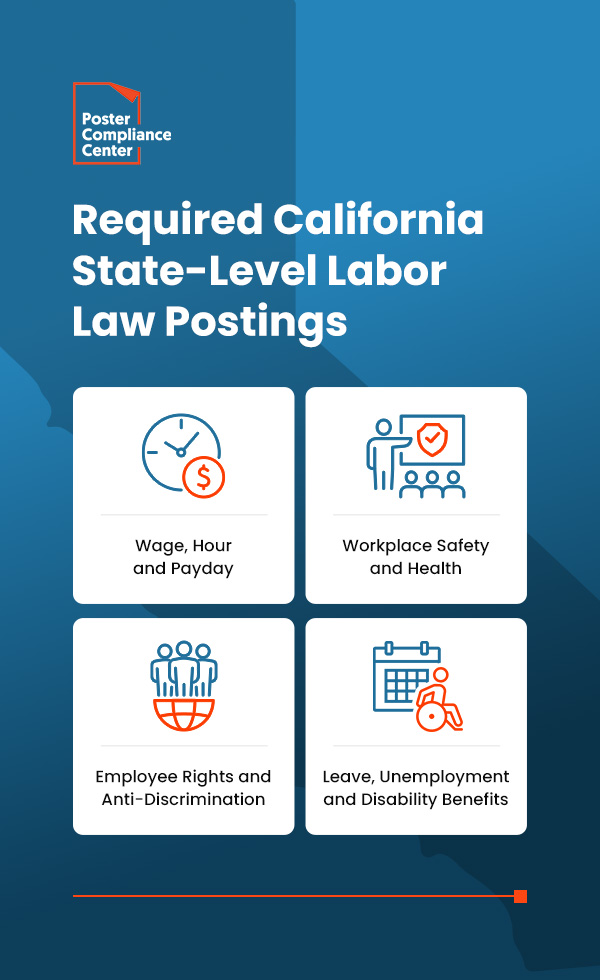
In addition to the mandatory federal law posting requirements, as an employer, you also must comply with the California Department of Industrial Relations’ (DIR) and its Labor Commissioner’s Office posting requirements. State posters are specific to local jurisdictions and cover stricter wage laws, paid sick leave and state safety plans. We’ll take a closer look at the key postings required for all employers based on various categories.
Wage, Hour and Payday Posters
We’ll start with postings relating to wages, work hours and paydays. You are required to display several wage-related posters in a clearly visible and easily accessible location that employees frequent during working hours, such as a break room, near a time clock or a central notice board.
Key posters within this category include:
- Payday Notice: California employers must post a notice specifying the pay frequency (weekly, biweekly or monthly), the set pay dates and the time and place for payment, such as check pickup points or direct deposit.
- California Minimum Wage Order: Under the California Labor Code, employers must post minimum wage and industry-specific wage orders that dictate specific rules for industries, including overtime, meal breaks and uniforms.
- Paid Sick Leave: All employers must conspicuously display a poster providing specific information about paid sick days under the California Healthy Workplaces/Healthy Families Act.
- Time Off to Vote: Employees have the right to take time off from work to vote if they do not have time outside of working hours. This notice must be posted at least 10 days before every statewide election.
As of January 1, 2026, the California minimum wage increased to $16.90 per hour for all employers.
Workplace Safety and Health Posters
The next category is workplace safety and health. From February 1 every year, employers must post various documentation that shares information on work-related injuries over the last year, employee health standards, safety data sheets and emergency response contact details to ensure a safe working environment.
These health and safety-related posters include:
- OSHA Form 300A: Also known as the Summary of Work-Related Injuries and Illnesses, the form is an annual document that summarizes all reportable workplace injuries and illnesses for the prior calendar year.
- Safety and Health Protection on the Job: Employers must post the California OSHA poster regarding occupational safety, job hazards and employee health standards.
- Access to Medical and Exposure Records: California’s Division of Occupational Safety and Health (DOSH), also known as Cal/OSHA, requires employers to post safety data sheets for workplace chemicals. Employees have the right to review their own medical records and records of exposure to toxic substances or harmful physical agents, as well as the exposure records of employees in similar work conditions.
- Emergency response phone numbers: The California Code of Regulations requires all employers to post emergency phone numbers near a telephone or to make them readily available if there isn’t a telephone at the jobsite.
- Smoking signs: All employers must post signage identifying permitted and prohibited smoking areas within the workplace.
Employee Rights and Anti-Discrimination Posters
California employment law is much broader than the federal EEO laws. The Fair Employment and Housing Act protects employees from discrimination and harassment. Employers are required to post information covering crucial employee protections to keep employees informed.
Employee rights and anti-discrimination posters required in the workplace include:
- Workplace Discrimination and Harassment: The law protects employees from discrimination and harassment across various protected categories, including age, ethnicity, disability, gender identity, marital status, medical conditions, military status, religion and sexual orientation. The poster must include information about employer obligations and the complaint process.
- Whistleblower Protections: A whistleblower is an employee who reports wrongdoing by an employer to a supervisor or authority. The California Labor Code requires employers to post whistleblower protection information in 14-point font or larger, including instructions for reporting improper conduct to the California State Attorney General.
- Transgender Rights: The California Civil Rights Department (CRD), formerly known as the Department of Fair Employment and Housing, requires employers to display a poster that defines the term “transgender,” describes gender transition, sets forth employer obligations and explains how victims can file a complaint.
- Workers’ Compensation Insurance Notice: Employers must post information about the workers’ compensation insurance carrier or a statement that they are self-insured. It must also include information on the injury, treatment and compensation.
- Notice to Employees: Provided by the California Division of Workers’ Compensation, this notice explains employees’ rights and benefits related to workplace injuries and the process to receive benefits.
- Pregnancy Rights: This poster explains an employer’s obligation to accommodate employees who are pregnant, have a medical condition related to their pregnancy or are recovering from childbirth.
Leave, Unemployment and Disability Benefits Posters
California employers must display posters informing employees of Unemployment Insurance (UI), Disability Insurance (DI) and Paid Family Leave (PFL) benefits.
Mandatory postings include:
- Family Care and Medical Leave and Pregnancy Disability Leave: Under the California Family Rights Act of 1993, employees have the right to 12 weeks of family care or medical leave within a 12-month period for the birth, adoption or foster care placement of a child. This act also covers serious health conditions that affect the employee, their child, parent or spouse. Employees may also have the right to family care leave under the New Parent Leave Act.
- Unemployment Insurance, Disability Insurance and Paid Family Leave: Issued by the California Employment Development Department (EDD), this poster outlines how employees can file for Unemployment Insurance, Disability Insurance and Paid Family Leave.
Special Requirements for Certain Industries

Depending on the industry, there might be additional specialized posting obligations that you need to keep in mind to remain compliant. California imposes industry-specific requirements tailored to unique hazards or labor conditions. Industries such as agriculture, healthcare, construction and hospitality have additional postings they need to include in their workplace notices.
Here are examples of additional compliance posters required for different industries:
- Restaurant and hospitality: In this industry, you must have a Food Handler Safety or Food Safety Certificate, choking hazard signs and alcohol service warnings.
- Construction: Additional postings for construction include Prevailing Wage Determinations, Specialized OSHA Construction Safety and Cal/OSHA Heat Illness Prevention.
- Agricultural: Employers are required to display notices such as Pesticide Warnings, Field Sanitation Notices and Farm Labor Contractor Registration.
- Healthcare: Facilities require postings including Patient Rights Notices, Medical Waste Handling Procedures and Healthcare Worker Protections.
Keeping up With Frequent Changes and Remote Workers
With labor law and workforce landscapes always evolving, keeping up with these changes can become overwhelming. But there are ways to ensure that you’re on top of these changes and remain compliant.
How Often Do California Labor Laws Change?
Changes to California Labor Laws can occur at any time during the year, making annual checks insufficient. When this happens, it’s crucial that posters are updated and replaced to ensure compliance and inform employees. Government agencies don’t need to notify businesses about new labor law updates, meaning you need to be aware of these changes to act quickly in keeping your compliance intact.
To help you stay current and compliant, we’ll keep you informed. We share the latest labor law updates across the country and in every state. Our expert team stays on top of all federal, state and local labor law changes to ensure you have the most recent posters for your workplace.
Compliance for Remote and Hybrid Employees
As physical workplaces shift toward remote and hybrid workforces, distributing notices is becoming more challenging. To ensure employees are informed and aware of various notices, businesses are allowed to use channels such as electronic distribution and intranet postings. While California Labor Code Section 1207 allows electronic distribution of notices, it does not relieve the obligation to display them physically.
Remote posting requirements include:
- Electronic posting: If employees work remotely full-time or if it’s the standard communication method, postings may be sent electronically, provided they are supplemented by physical postings if a central office exists.
- Annual notice updates: By February 1 each year, employers must provide the required workplace rights notices directly to employees.
- Emergency contact notice: Employers must provide employees with opportunities to designate an emergency contact.
- Accessibility: Digital postings must be accessible without special permissions and located in a frequently visited area, such as a company intranet.
- Language: If 10% or more of employees speak another language, posters must also be displayed in that language.
A Simplified Solution for Guaranteed Compliance at Poster Compliance Center
Staying compliant can be tricky. It’s complex and continuous. With new labor laws and evolving workforce structures, having all the necessary and relevant information is essential for keeping your employees informed and giving you peace of mind. This is why we’re here to help. Poster Compliance Center simplifies tracking updates and ensures ongoing compliance without manual research.
Our labor law posters include all mandatory state and federal labor law notices, guaranteeing your posters are always compliant with employment poster regulations. Our dedicated service provides corporate compliance solutions for managing poster updates across multiple locations and jurisdictions. Have a hybrid or remote workforce? We help with that too, with our eComply360 Digital Compliance Platform.